
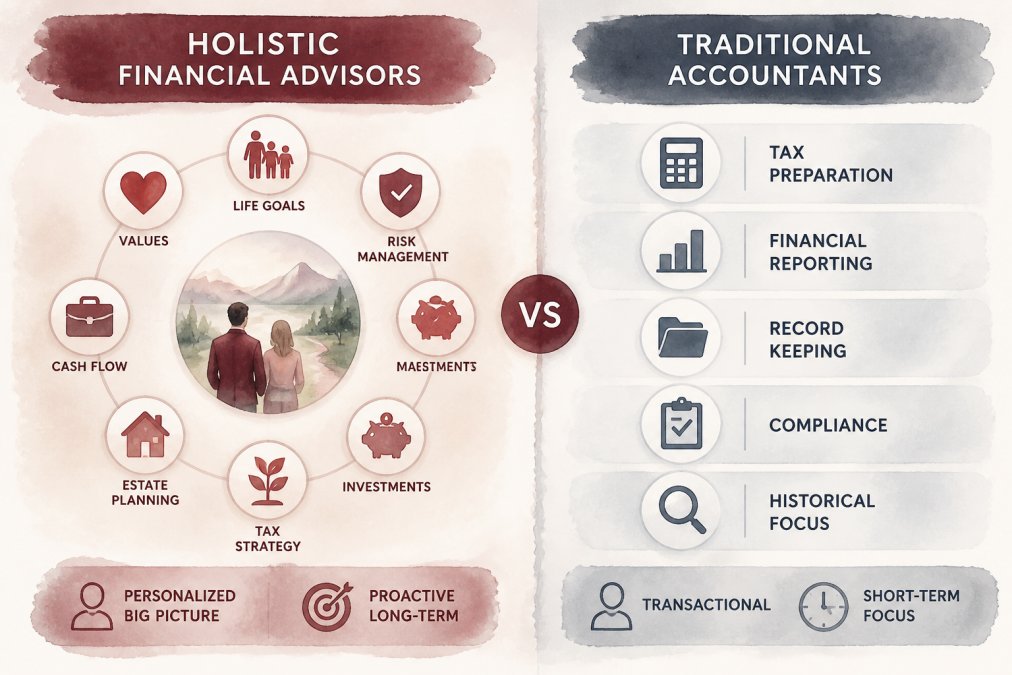
 comparison
Holistic Financial Advisors vs Traditional Accountants
Table of Contents
- Holistic Financial Advisors vs Traditional Accountants: What's the Difference?
- CPA vs Financial Planner for Tax Strategy: Who Does What?
- Comprehensive Tax Planning Westchester Trusts
- Frequently Asked Questions
Last Updated: September 7, 2026
Holistic Financial Advisors vs Traditional Accountants: What's the Difference?
The choice between holistic financial advisors vs traditional accountants comes down to scope: one focuses on your entire financial life, the other on compliance-driven tax filing. Holistic financial advisors build a strategy around your life goals, while a traditional accountant ensures accurate tax returns and clean books. Most people need both, but rarely at the same time.
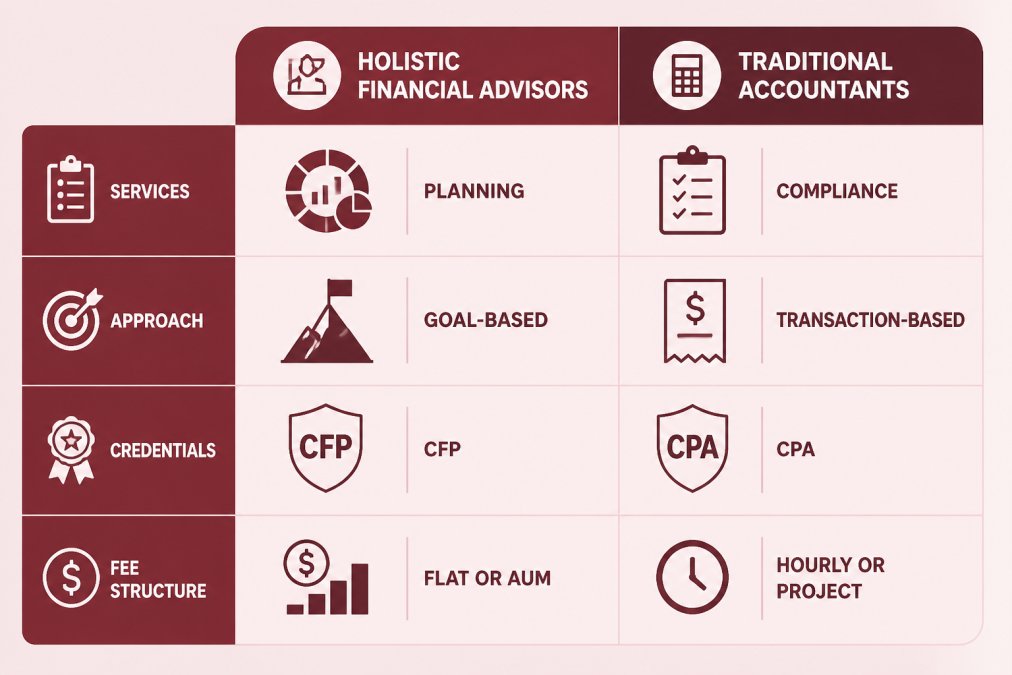
| Aspect | Holistic Financial Advisor | Traditional Accountant |
|---|---|---|
| Primary Focus | Life goals and wealth strategy | Tax compliance and accuracy |
| Typical Credentials | CFP, CFA | CPA, EA |
| Services | Retirement, estate, investment planning | Tax prep, bookkeeping, audits |
| Fee Model | Flat fee or % of assets | Hourly, project, or annual retainer |
| Best For | Long-term strategy | Annual filing and reporting |
| Engagement | Ongoing relationship | Often seasonal |
CPA vs Financial Planner for Tax Strategy: Who Does What?
A CPA is often the better choice for tax strategy because they have direct, working knowledge of the tax code. While a financial planner can identify general tax-saving opportunities, a CPA for tax strategy can execute on them with precision, a planner spots the opportunity; a CPA makes sure it is legal, documented, and filed correctly.
For business owners, the CPA's role expands into entity selection, payroll, and sales tax, areas a planner rarely touches.
Comprehensive Tax Planning Westchester Trusts
For Mamaroneck and Westchester County residents, comprehensive tax planning Westchester requires coordinating state and local considerations alongside federal strategy, including New York's specific rules around itemized deductions and estate taxes. Trusts add another layer: powerful for estate planning and asset protection, but complex in tax treatment.
A hybrid firm like Paldino Company CPA combines the technical rigor of a CPA with the forward-looking mindset of an advisor, offering virtual CFO services and year-round support. If you are searching for holistic financial advisors near me who also understand the tax landscape, the answer may be a CPA-led practice.
Choosing between holistic financial advisors vs traditional accountants does not have to be either-or. The challenge is finding a partner who understands both strategy and compliance and stays engaged beyond tax season. Paldino Company CPA brings a creative, human-centered approach to accounting and advisory work, serving clients in Mamaroneck and throughout Westchester County with year-round tax help and clear, empathetic guidance. Schedule an appointment to build a financial plan that actually fits your life.
Frequently Asked Questions
What is the main difference between a holistic financial advisor and a traditional accountant?
A traditional accountant focuses on the past and present: accurate bookkeeping, financial statement preparation, and tax compliance. A holistic financial advisor looks forward, integrating tax strategy with your broader financial life, including investments, retirement, and cash flow. While an accountant answers 'what do I owe?', a holistic advisor helps answer 'how do I structure my finances to owe less and grow more?'
Do I need both a CPA and a financial advisor for comprehensive tax planning?
Often, yes. A CPA holds the expertise to prepare and file accurate tax returns and ensure compliance with IRS regulations. A financial planner focuses on strategy, like optimizing retirement withdrawals or investment allocations. For comprehensive tax planning Westchester residents and business owners often benefit from a team approach or a firm that offers both advisory and CPA services to ensure your tax strategy is fully integrated with your financial plan.
How does a human-centered approach to finance impact tax planning?
A human-centered approach means advice starts with your personal goals, not just your numbers. Instead of generic tax tips, the focus is on your specific situation, like your business structure, income streams, and life changes. This leads to proactive, year-round planning rather than a once-a-year review, ensuring your tax strategy supports your broader financial objectives and reduces surprises at filing time.