 How-to
How to Assess Legal Liability Risks as a New York General Partner
Last Updated: October 30, 2026
Quick Summary
Under a general partnership in New York, each partner can be personally liable for business debts, so creditors can reach personal assets such as a home and savings. The legal liability risks for general partners depend heavily on how the partnership agreement defines duties, sharing of losses, and membership rules. Owners should review these terms with a professional before signing anything.
- Creditors can reach personal assets, not just business property, under a general partnership.
- Partners may be responsible for debts they did not personally create.
- A written partnership agreement should define duties, authority, and how losses are shared.
- A liability shield in some forms limits exposure only to certain third-party debts.
- An LLC generally gives owners more protection from business debts than a general partnership.
Table of Contents
- How General Partner Personal Liability for Business Debts Works in New York
- How New York Partnership Agreement Liability Clauses Shape Your Exposure
- Choosing Between a General Partnership and an LLC in New York, and Protecting Your Assets
- Frequently Asked Questions
How General Partner Personal Liability for Business Debts Works in New York
Under a general partnership, each partner can be personally liable for the debts of the business. Paldino Company CPA helps New York owners understand what that means before they sign anything. The legal liability risks for general partners in New York start with this basic rule.
Key point: Personal assets can be reached by creditors, not just business property.
- A partner's home, savings, and other personal assets may be at risk
- Liability can extend to debts a partner did not personally create
- Partners may be responsible for the actions of other partners in the business
A 2005 Duke University School of Law study describes unlimited liability as a default rule that applies when partners do not define their arrangement clearly (Duke University School of Law empirical study on general partnership liability).
How New York Partnership Agreement Liability Clauses Shape Your Exposure
A written partnership agreement can define how liability and responsibilities are shared among partners. Clear terms help set expectations, but they do not always limit what creditors can reach. Review your agreement with a professional before you rely on it.
- Define each partner's duties and authority
- Address how losses and debts are shared between partners
- Set rules for adding or removing partners
Under New York law, a liability shield in some partnership forms limits exposure only for certain third-party debts. It does not remove a partner's duty to account to the partnership (New York LLP liability shield guidance).
The article points to a few concrete elements a partnership agreement should cover and the limits of any liability shield.
| Element | What it addresses | Note |
|---|---|---|
| Partner duties and authority | Who does what in the business | Define in the written agreement |
| Sharing of losses and debts | How partners divide financial responsibility | Address between partners |
| Adding or removing partners | Membership changes | Set rules in advance |
| Liability shield in some forms | Limits exposure to certain third-party debts | Does not remove duty to account |
Choosing Between a General Partnership and an LLC in New York, and Protecting Your Assets
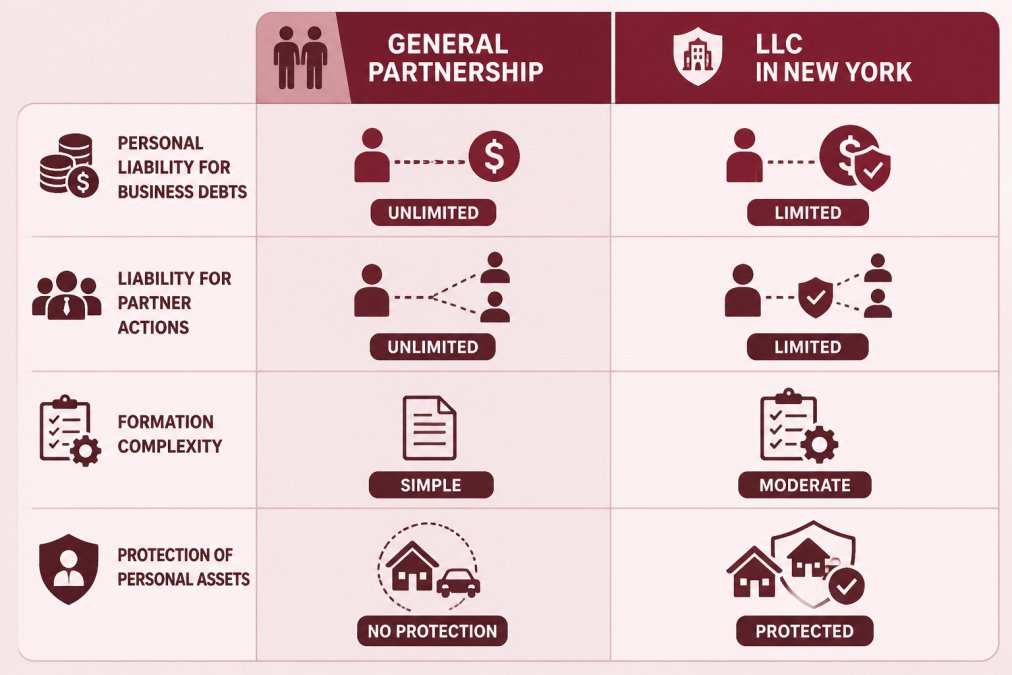
A limited liability company (LLC) generally gives owners more protection from business debts than a general partnership. Compare the options in our guide to choosing the right business entity. Many New York owners compare the two before forming a business.
Watch out: Mixing personal and business money can weaken the separation between you and the business. Learn how separating personal and business finances with distinct bank accounts and credit cards can help.
Talk with a CPA or attorney about which structure fits your situation. Paldino Company CPA can help you review your options and organize your finances.
Frequently Asked Questions
Are general partners personally liable for business debts in New York?
Yes. Under New York's general partnership rules, each general partner can be held personally liable for the partnership's debts and obligations, and creditors can pursue a partner's personal assets if the partnership cannot pay. This unlimited exposure is the central reason many owners examine other structures. Because the rules are set by New York statute, review the current text of the Partnership Law or speak with a qualified attorney before relying on any specific protection. Paldino Company CPA can help you understand how your partnership's finances affect your personal exposure.
Can one general partner make the other partners personally liable?
Generally, yes. In a general partnership, a partner acting within the scope of the business can bind the partnership and, through it, the other partners to contracts and obligations. This is why the partnership agreement matters: it can set limits on authority and spell out how decisions are made, though those limits may not bind outside creditors who had no notice of them. Review how your agreement addresses authority, and confirm the details with a qualified attorney.
What is the difference between a general partnership and an LLC in New York?
A general partnership generally exposes each partner's personal assets to business debts and to liability arising from partners' actions in the business. A limited liability company generally separates the owners' personal assets from the company's obligations, though members can still be liable for their own wrongful acts and for personal guarantees. Formation requirements, filing fees, and tax treatment also differ. Consult a qualified professional about which structure fits your situation.