 ultimate-guide
How to Choose a Business Entity: A 2026 Guide
Table of Contents
- The 4 Main Business Entity Types Explained
- LLC vs S Corp Tax Differences: Which Structure Saves More
- Liability Protection, the Corporate Veil, and Your Personal Assets
- How to Choose a Business Entity: 6 Factors That Actually Decide It
- Cost of Forming an LLC vs Corporation in New York
- How to Register a Business Entity: Step-by-Step
- State-Specific Requirements and Entity Conversion in New York
- Post-Formation Compliance Checklist for New Business Owners
Last Updated: August 2, 2026
Choosing the right business entity is one of the most consequential decisions you'll make as a founder. The wrong structure costs more than most people expect, in unnecessary taxes, unprotected personal assets, or missed capital-raising opportunities. At Paldino Company CPA, we work with freelancers, creative agencies, and small business owners across New York and Westchester County who often discover years later they're operating under the wrong structure. The entity you choose affects your tax bill, liability exposure, ability to raise capital, and annual compliance burden. Your entity should match where your business is now and where it's headed in the next three to five years.
The 4 Main Business Entity Types Explained
A business entity is the legal structure through which your business operates, owns assets, and incurs liability.
Sole Proprietorship
A sole proprietorship is the default structure for any individual operating a business without formally registering a separate entity. There is no separation between you and the business: you report income on Schedule C of your personal return, and you're personally responsible for every debt and legal claim the business faces. The upside is simplicity; the downside is total personal liability. If a client sues your freelance design business and wins, your personal bank accounts, car, and home are all at risk.
Who it fits: Solo operators with low liability risk and modest income who are testing a concept before committing to a formal structure.
General Partnership
A general partnership forms automatically when two or more people operate a business together for profit. Like a sole proprietorship, there's no liability separation. Each partner is personally liable for the debts and actions of the other partners. Pass-through taxation applies: profits flow to each partner's personal return and are subject to self-employment tax. Without a written partnership agreement, disputes are resolved by your state's default partnership laws, which rarely favor anyone.
Limited Liability Company (LLC)
The limited liability company is the most popular entity choice for small businesses in the United States. It combines the liability protection of a corporation with the tax flexibility of a partnership. Members are generally shielded from personal liability for business debts, preserving the corporate veil between personal and business assets.
By default, a single-member LLC is taxed as a sole proprietorship, and a multi-member LLC is taxed as a partnership. Both use pass-through taxation, meaning profits appear on members' personal returns and avoid the double taxation that hits C-corporations. LLCs require an operating agreement, which governs how the business is managed, how profits are distributed, and what happens when a member exits.
C-Corporation and S-Corporation
A C-corporation is a separate legal entity owned by shareholders. It files its own tax return and pays corporate income tax on profits. When those profits are distributed as dividends, shareholders pay tax again on their personal returns, double taxation, which is why most small businesses avoid C-corp status until seeking venture capital.
An S-corporation is a tax classification, not a separate entity type. A corporation or LLC can elect S-corp status with the IRS to achieve pass-through taxation while maintaining a corporate structure. S-corps require shareholders to pay themselves a reasonable salary subject to payroll taxes, but additional profit distributions are not subject to self-employment tax, where the tax savings come from.
LLC vs S Corp Tax Differences: Which Structure Saves More
The LLC vs S Corp tax question depends almost entirely on your net profit level.
A single-member LLC with no tax election pays self-employment tax on 100% of net profit. An LLC or corporation with an S-corp election pays payroll taxes only on the owner's reasonable salary. The remaining profit passes through as a distribution, free of self-employment tax.
| Structure | Self-Employment Tax | Double Taxation | Payroll Required | Best For |
|---|---|---|---|---|
| Sole Proprietorship | On all net profit | No | No | Very early stage, low income |
| Single-Member LLC | On all net profit | No | No | Flexibility, low complexity |
| LLC with S-Corp Election | On salary only | No | Yes | Profitable small businesses |
| S-Corporation | On salary only | No | Yes | Established businesses, tax savings |
| C-Corporation | Not applicable | Yes | Yes | VC-backed, high-growth, IPO track |
| General Partnership | On all net profit | No | No | Simple co-founder arrangements |
The S-corp election becomes meaningful when your net profit is high enough that the cost of running payroll is less than the self-employment tax you'd save.
Liability Protection, the Corporate Veil, and Your Personal Assets
The corporate veil is the legal boundary between your personal assets and your business's liabilities. When that boundary is respected, a creditor who wins a judgment against your business can't come after your personal savings, home, or car.
Many small business owners inadvertently pierce their own corporate veil by mixing personal and business finances, failing to maintain separate bank accounts, not signing contracts in the business's name, or skipping required annual filings. Courts have found grounds to hold owners personally liable despite having a formal entity. Asset protection is not automatic, it requires ongoing compliance.
According to IRS guidance on business structures and liability, the structure you choose affects how the IRS treats your income and how state courts view your liability exposure.
A sole proprietorship and general partnership offer zero liability protection. An LLC or corporation, properly maintained, shields personal assets from most business claims.
How to Choose a Business Entity: 6 Factors That Actually Decide It
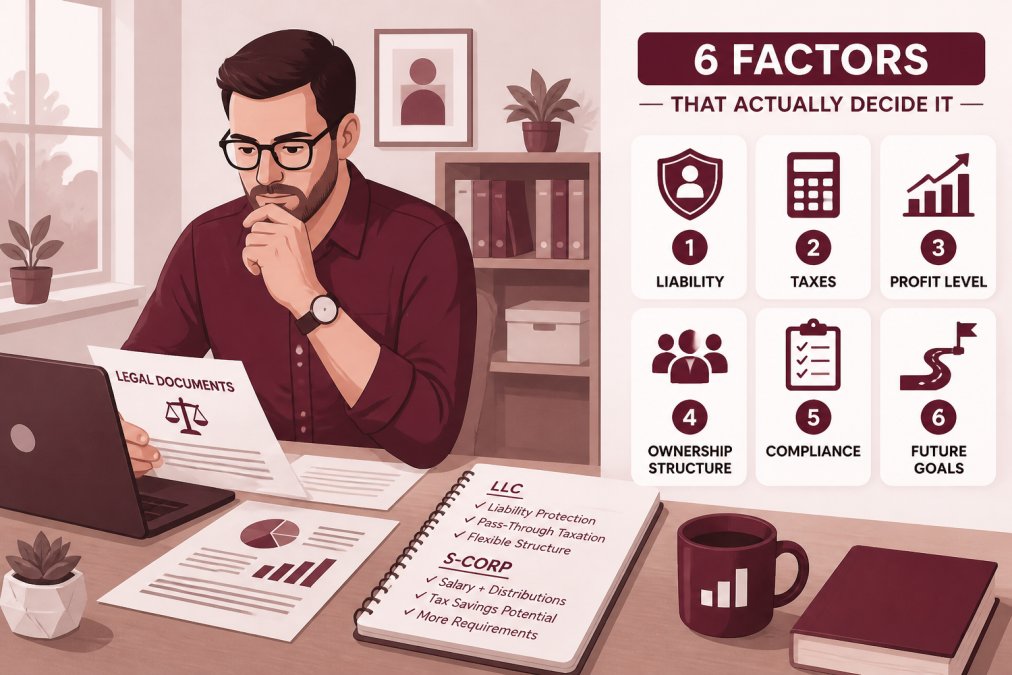
Choosing the right business entity comes down to six practical factors. Most founders over-index on taxes and under-index on everything else.
Risk Tolerance and Personal Liability Exposure
The first question is honest: what happens if the business gets sued or can't pay its debts? A freelance copywriter with no employees has relatively low liability risk. A catering company, construction firm, or any business where clients or employees could be physically harmed faces serious personal liability exposure. Higher risk businesses benefit most from the liability protection an LLC or corporation provides.
Tax Classification and Self-Employment Tax
Your entity choice determines your tax filing status and how self-employment tax applies to your income. A sole proprietor pays self-employment tax on all net profit. An S-corp election changes that calculation significantly for profitable businesses. Capital gains treatment, how you handle business losses, and your employer identification number requirements all flow from this decision.
Business Growth Plans and Succession Planning
A sole proprietorship cannot have investors. A general partnership makes raising capital complicated. If you plan to bring on co-founders, seek outside investment, or build a business you'll eventually sell, you need an entity that supports succession planning and equity distribution. C-corporations are the standard for venture-backed startups. LLCs work well for most small businesses that want flexibility without full corporate overhead.
Industry-Specific Entity Considerations
Some industries have restrictions on entity type. Licensed professionals in New York, including attorneys, physicians, and accountants, are often required to form a Professional Corporation or Professional Limited Liability Company. Real estate investors frequently use LLCs for each property to isolate liability. Creative agencies and consulting firms typically find the LLC with an S-corp election to be the most tax-efficient structure once revenue reaches a meaningful level.
Cost of Forming an LLC vs Corporation in New York
New York is one of the more expensive states in which to form and maintain a business entity. For an LLC in New York, the state charges a filing fee for the Articles of Organization. New York also requires new LLCs to publish a notice of formation in two newspapers in the county where the LLC's office is located for six consecutive weeks. This publication requirement can add significant cost depending on the county, with New York County and certain Westchester County publications among the more expensive options.
Corporations face their own formation fees, plus ongoing franchise tax obligations and annual reporting requirements.
According to New York Department of State business entity formation requirements, all entities must maintain a registered agent and keep their address current with the state to remain in good standing.
Contact Paldino Company CPA directly for guidance on formation and ongoing compliance support for your specific situation.
How to Register a Business Entity: Step-by-Step
Registering a business entity in New York follows a clear sequence. Skipping steps or doing them out of order creates problems that are expensive to fix later.
- Choose your entity type. Use the six-factor framework above.
- Choose a business name. Search the New York Department of State's entity database to confirm availability. LLCs must include "LLC" or "Limited Liability Company" in the name.
- Appoint a registered agent. New York requires every LLC and corporation to designate a registered agent with a physical address in the state.
- File formation documents. LLCs file Articles of Organization. Corporations file a Certificate of Incorporation with the New York Department of State.
- Obtain an Employer Identification Number. Apply for an EIN through the IRS. You need this to open a business bank account, hire employees, and file business taxes.
- Draft an operating agreement or bylaws. New York requires LLCs to have an operating agreement. Corporations need bylaws. These documents govern internal operations and protect the corporate veil.
- Satisfy New York's publication requirement (LLCs only). Publish in two approved newspapers for six consecutive weeks, then file a Certificate of Publication with the Department of State.
- Open a dedicated business bank account. Do this before you receive any business income. Commingling funds is one of the fastest ways to lose liability protection.
- Register for state and local taxes. Depending on your business type, you may need to register for New York sales tax, payroll taxes, or other state-specific obligations.
- Obtain any required licenses or permits. Industry-specific requirements vary. Confirm what your profession or business type requires at the city, county, and state level.

As documented in IRS Employer Identification Number application guidance, EIN applications can be completed online and the number is issued immediately for most entity types.
State-Specific Requirements and Entity Conversion in New York
New York's Unique Filing Requirements
New York imposes requirements that don't exist in most other states. The LLC publication requirement is the most significant. After filing Articles of Organization, you have 120 days to complete publication in two newspapers designated by the county clerk. Failure to comply results in suspension of the LLC's ability to conduct business in New York. The cost varies dramatically by county: Manhattan's designated newspapers are among the most expensive in the state, while some upstate counties cost a fraction of that amount.
New York also imposes an annual filing fee on LLCs based on gross income from New York sources, separate from the standard franchise tax that applies to corporations.
Entity Conversion Roadmap: When and How to Switch
Many businesses start as sole proprietorships or single-member LLCs and later need to convert to a different structure. The most common conversion path is from a single-member LLC to an LLC with an S-corp election as profitability grows.
Conversion typically makes sense at these points:
- Sole proprietorship to LLC: As soon as you have clients, contracts, or meaningful revenue. The liability protection is worth the formation cost almost immediately.
- LLC to S-corp election: When your net profit reaches a level where the self-employment tax savings on distributions exceed the cost of running payroll and additional compliance.
- LLC or S-corp to C-corporation: When you're pursuing institutional venture capital or planning a liquidity event that requires a standard corporate structure.
Entity conversion can trigger tax consequences. Get professional guidance before initiating a conversion.
Post-Formation Compliance Checklist for New Business Owners
Formation is the beginning, not the end. Many business owners complete their registration and then neglect the ongoing obligations that keep their entity in good standing and their corporate veil intact.
Use this checklist after formation:
- Open a dedicated business bank account and business credit card
- Execute your operating agreement (LLC) or bylaws (corporation) and keep a signed copy
- File for your Employer Identification Number with the IRS if not already done
- Register for New York state taxes through the Department of Taxation and Finance
- Complete the LLC publication requirement within 120 days (New York LLCs only)
- File the Certificate of Publication with the Department of State after publication is complete
- Set a calendar reminder for your annual LLC filing fee due date
- Confirm any industry-specific licenses or permits are in place before operating
- Establish a bookkeeping system and keep business finances strictly separate from personal
- Review your operating agreement or bylaws with a CPA or attorney annually
- Confirm your registered agent information is current with the Department of State
- If electing S-corp status, file IRS Form 2553 within the required window after formation or at the start of the tax year
According to New York Department of Taxation and Finance business tax registration, most businesses operating in New York must register for state taxes before making their first sale or hiring their first employee.
Compliance is a recurring priority, not an afterthought. The businesses that maintain their liability protection and avoid IRS scrutiny are the ones that treat these obligations as ongoing responsibilities.
Choosing the right business entity is genuinely complex, especially in New York where state-specific requirements add layers that most national guides skip entirely. Paldino Company CPA works directly with small business owners and freelancers in New York and Westchester County to clarify exactly which structure fits your situation, handle formation paperwork, and provide year-round tax support. If you're ready to stop guessing and get a clear answer tailored to your business, schedule an appointment with Paldino Company CPA today.
Frequently Asked Questions
What is the simplest business entity to form?
A sole proprietorship is the simplest business entity to form. It requires no formal registration at the state level, no articles of organization, and no operating agreement. You are the business, and income flows directly to your personal tax return. The tradeoff is that you have zero personal liability protection, meaning creditors can come after your personal assets. For freelancers or very early-stage businesses, it works as a starting point, but most owners outgrow it quickly.
What are the LLC vs S Corp tax differences I should know about?
Both an LLC and an S-Corporation use pass-through taxation, so business income flows to your personal return and avoids double taxation. The key LLC vs S Corp tax difference is how self-employment tax works. As a single-member LLC, all net profit is subject to self-employment tax. With an S-Corp election, you pay yourself a reasonable salary, and only that salary faces payroll taxes. Profit distributions above your salary are not subject to self-employment tax, which can produce meaningful savings once your net income is high enough to justify the added compliance.
Does my business entity choice affect my personal liability?
Yes, directly. A sole proprietorship and a general partnership offer no separation between your personal assets and business debts. If your business is sued or cannot pay its bills, your personal savings, home, and other assets are exposed. An LLC and a corporation both create a legal separation known as the corporate veil. As long as you maintain that separation by keeping finances separate, following statutory requirements, and not personally guaranteeing debts unnecessarily, your personal assets stay protected.
How do I decide between an LLC and a C-Corp?
The decision usually comes down to your growth plans and investor strategy. An LLC offers flexibility, pass-through taxation, and simpler compliance, making it the right fit for most small businesses and self-employed professionals. A C-Corporation allows you to issue multiple classes of stock and accept venture capital, but it faces double taxation: the corporation pays corporate income tax, and shareholders pay capital gains tax on dividends. If you are not seeking institutional investment, an LLC is almost always the more practical choice to start.
Do I need a lawyer to choose and register my business entity?
You are not legally required to hire an attorney to register a business entity, but professional guidance from a CPA or attorney is worth the cost for most people. Entity selection has lasting tax and liability consequences that are difficult to reverse cleanly. A CPA can model the tax impact of each structure against your actual revenue projections, flag state-specific requirements like New York's publication rule for LLCs, and set up your employer identification number and operating agreement correctly from day one.
What is the cost of forming an LLC vs a corporation in New York?
In New York, forming an LLC requires a $200 filing fee with the Department of State, plus a publication requirement that mandates running a notice in two newspapers for six consecutive weeks, which can cost anywhere from a few hundred to over a thousand dollars depending on the county. Forming a corporation in New York carries a minimum $125 filing fee, though it varies by authorized shares. Ongoing compliance costs, including biennial statements and registered agent fees, apply to both structures. Always verify current fees directly with the New York Department of State.
This article was written using GrandRanker