 How-to
How to Organize Financial Records for Tax Season
Table of Contents
- Step 1: Build Your Tax Document Checklist
- Step 2: Learn How to Organize Tax Receipts
- Step 3: Apply Tax Record Retention Guidelines
- Frequently Asked Questions
Last Updated: October 19, 2026
Step 1: Build Your Tax Document Checklist
Learning how to organize financial records for tax season starts with one page: a written list of every form, statement, and receipt you need before you file. At Paldino Company CPA, we hand clients a checklist first because it turns a stressful pile into a clear to-do list.
Start with these core items:
- W-2s from every employer
- 1099s for freelance or contract work
- Mortgage interest statements (Form 1098)
- Bank and brokerage year-end summaries
- Charitable donation receipts
- Business expense receipts, if self-employed
Keep the list in a folder or note you can check off. Add items as they arrive, and note anything missing early so you can request a copy. The IRS guidance on recordkeeping is a solid starting reference for what to keep.
Step 2: Learn How to Organize Tax Receipts
Tax receipt organization means capturing, labeling, and storing every receipt the moment you get it, not in April.
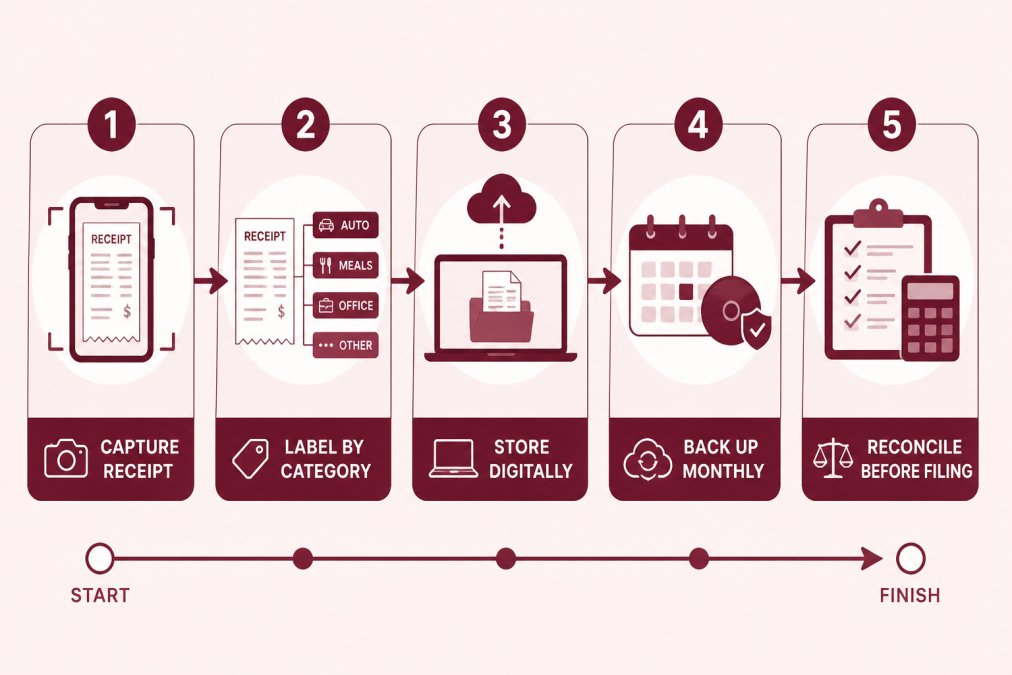
- Capture every receipt with your phone the same day.
- Label it by category: travel, supplies, meals, mileage.
- Store it in one cloud folder and back it up monthly.
- Reconcile receipts against bank statements before you file.
A shoebox sorted once a year means lost deductions and hours of guesswork; digital capture takes seconds.
Step 3: Apply Tax Record Retention Guidelines
Tax record retention guidelines tell you how long to keep documents after you file: most supporting records for at least three years, longer for certain items.
The IRS guidance on how long to keep records sets the general rule at three years from the filing date. Keep records longer if you:
- Claimed a loss on worthless securities (up to seven years)
- Underreported income and need extra protection
- Own property, where records stay as long as you hold it, plus the retention period after sale
For small business tax records, add an archive folder by year labeled with a "keep until" date.
| Record Type | Keep For | Why |
|---|---|---|
| W-2s and 1099s | 3 years | Supports reported income |
| Receipts and invoices | 3 years | Backs up deductions |
| Property records | Ownership plus 3 years | Needed at sale |
| Worthless security losses | 7 years | Extended review window |
If you want help building a system that fits your situation, especially for a small business in Mamaroneck, our team at Paldino Company CPA offers year-round support and virtual CFO services. You can review IRS filing and recordkeeping basics any time, or schedule an appointment with us and stop reorganizing the same pile every spring.
Frequently Asked Questions
How should I organize my financial records for tax season?
Start with a single home for everything: one folder or cloud directory per tax year, split into income, deductions, and supporting documents. Add receipts as they arrive instead of saving them for spring. Then run a checklist against last year's return to confirm nothing is missing. If you organize financial records this way, filing becomes a review task rather than a scramble, and your preparer gets clean documents instead of a shoebox.
How long should I keep tax records?
The IRS generally recommends keeping records that support your return for at least three years from the filing date, and six years if you underreport income by more than 25%. Keep records longer for property, investments, and anything tied to an open matter. Because these thresholds are general guidelines, confirm the current rule on IRS.gov or with a CPA before shredding anything.
Should I keep tax records digitally or on paper?
Digital works well for most people: scan receipts, save statements as PDFs, and back everything up to a second location. The IRS accepts electronic records as long as they are legible and reproducible. Paper still makes sense for signed documents and anything you want a physical original of. Pick one primary system and be consistent, because a mixed pile of paper and files is where deductions get lost.