
 ultimate-guide
Is NY Pass-Through Entity Tax Worth It?
Table of Contents
- How the NY Pass-Through Entity Tax Works
- How to Calculate Your NY PTET Savings
- NYC PTET vs NYS PTET: Key Differences
- NY PTET Election Deadline and Next Steps
- Frequently Asked Questions
Last Updated: September 4, 2026
How the NY Pass-Through Entity Tax Works
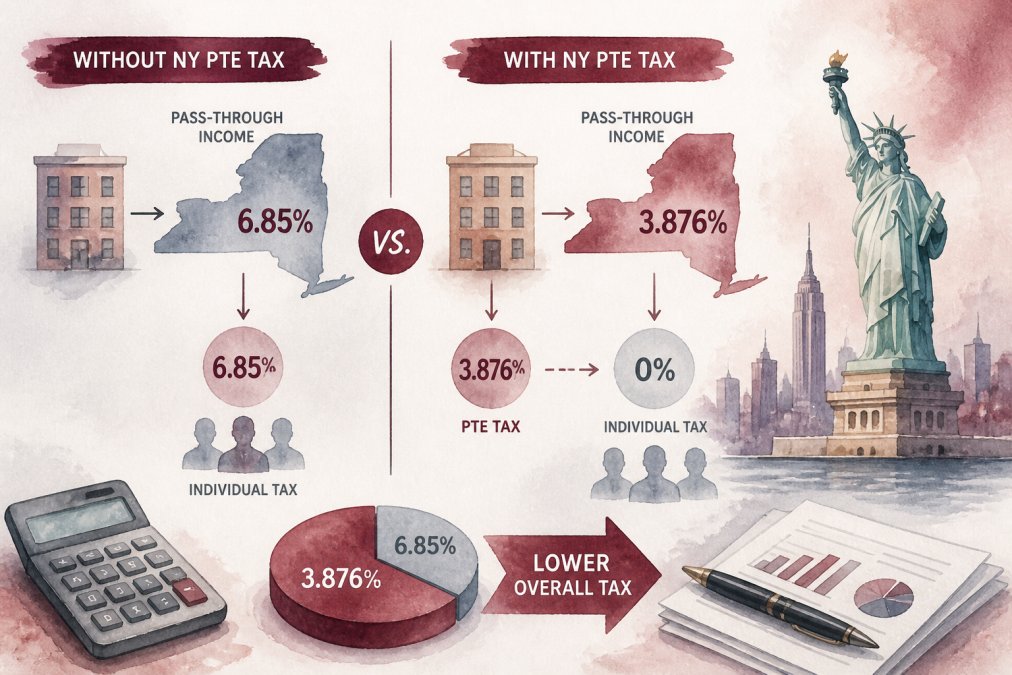
The NY pass-through entity tax is an elective annual tax for S corporations, partnerships, and LLCs taxed as partnerships. It converts non-deductible state tax into a deductible business expense by allowing the entity to claim the federal deduction instead of the individual owner.
The core mechanic: business owners in New York face a federal cap on state and local tax deductions. By shifting the tax burden to the entity, the entity claims the deduction at the federal level instead, unlocking savings that would otherwise be unavailable.
The NY PTET operates on a separate tax return and generates a credit against the owner's personal state tax liability.
How to Calculate Your NY PTET Savings
Your NY PTET savings depend on your business income, federal marginal rate, and New York state tax rate.
A simplified calculation works like this: if your business generates $200,000 in New York-sourced income and your combined federal and state marginal rates sit near 35%, the state PTET paid at the entity level reduces your federal taxable income. The net benefit is roughly the state tax paid multiplied by your federal marginal rate, minus any administrative costs. New York State Department of Taxation and Finance PTET guidance provides the official worksheets and rate tables for this computation.
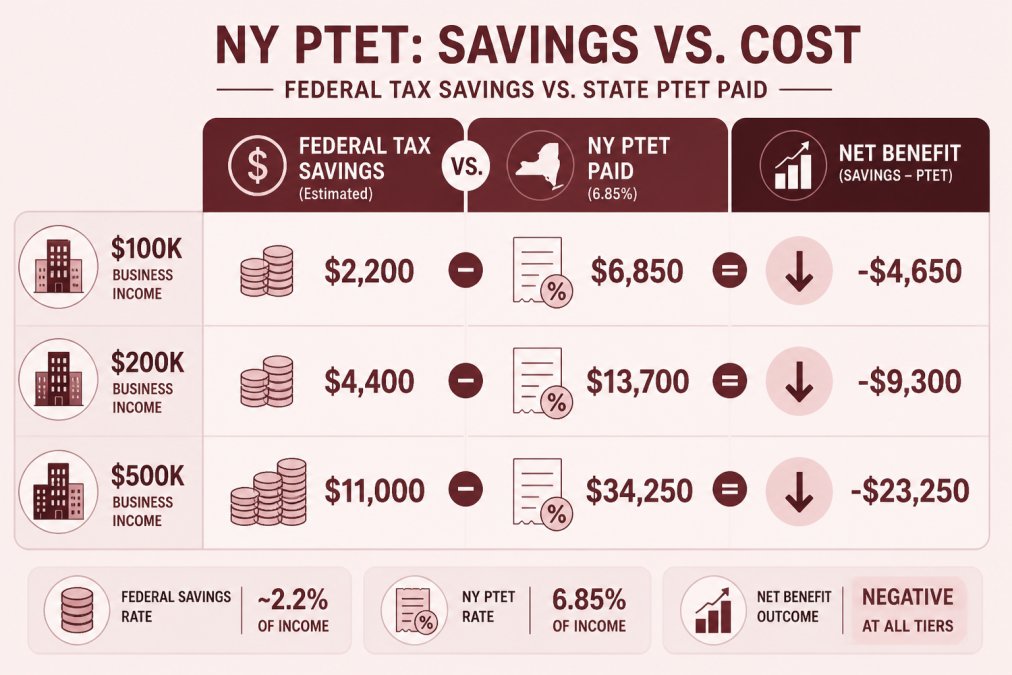
A common mistake is focusing only on the federal deduction while ignoring the timing burden of quarterly estimated payments and cash flow requirements.
| Business Income | PTET Paid (Est.) | Federal Deduction Value (Est.) | Net Savings (Est.) |
|---|---|---|---|
| $100,000 | $6,500 | $1,800 | $1,800 |
| $200,000 | $13,000 | $3,600 | $3,600 |
| $500,000 | $32,500 | $9,000 | $9,000 |
NYC PTET vs NYS PTET: Key Differences
The New York City and New York State pass-through entity taxes are separate elections with different rates and filing requirements. A business may be subject to one, the other, or both.
For NYC businesses, the city-level PTET applies to the city's share of income; the state-level PTET applies to New York State income. Businesses outside the five boroughs generally interact only with the state-level election unless owners are NYC residents.
The rates and thresholds differ between the two programs, and the credit mechanics on the owner's personal return work independently. This is where many business owners near me in Westchester get tripped up: they assume one election covers both jurisdictions, then discover a separate city filing is required. NYC Department of Finance PTET information clarifies which entities must consider the additional city-level election.
NY PTET Election Deadline and Next Steps
The NY PTET election deadline is March 15 of the tax year. Missing this deadline forfeits that year's deduction.
The election is made annually through the New York State Department of Taxation and Finance's online portal. Once elected, the entity must make estimated PTET payments on the same schedule as other business taxes. NYS PTET election and payment deadlines publishes the current year's dates and the required forms.
For business owners weighing the NY pass-through entity tax, analysis should happen before year-end. Cash flow planning, owner residency, and multi-state income all shift the outcome. Contact Paldino Company CPA in Mamaroneck to model both scenarios and determine whether the PTET makes sense for your business.
== FAQ ANSWERS (ARTICLE CONTENT, AUDIT EACH ONE SEPARATELY, SAME RULES) ==
Frequently Asked Questions
What is the New York State Pass-Through Entity Tax (PTET)?
The NY PTET is a state-level tax that allows pass-through entities, like S-corporations, partnerships, and LLCs, to pay a state tax on business income rather than having owners report it on personal returns. This creates a federal deduction for the state tax paid, potentially lowering overall federal tax liability. It's an optional election designed to help business owners benefit from the federal deduction while maintaining pass-through status.
How do I calculate whether NY PTET savings make sense for my business?
To understand potential NY PTET savings, you can consider how the federal deduction benefit compares to the state tax cost. The larger your income and the higher your federal tax bracket, the greater the potential benefit. Consult a tax professional to model your specific situation.
Is there a deadline to elect into the NY PTET?
Yes. The NY PTET election deadline is typically tied to your business tax return deadline. Confirm the exact deadline for your entity type with a tax advisor, as it varies by entity classification and filing status.
This article was written using GrandRanker
Frequently Asked Questions
Q: What is the New York State Pass-Through Entity Tax (PTET)?
A: The NY PTET is a state-level tax that allows pass-through entities—like S-corporations, partnerships, and LLCs—to pay a state tax on business income rather than having owners report it on personal returns. This creates a federal deduction for the state tax paid, potentially lowering overall federal tax liability. It's an optional election designed to help business owners benefit from the federal deduction while maintaining pass-through status.
Q: How do I calculate whether NY PTET savings make sense for my business?
A: To understand potential NY PTET savings, you can consider how the federal deduction benefit compares to the state tax cost. The larger your income and the higher your federal tax bracket, the greater the potential benefit. Consult a tax professional to model your specific situation.
Q: Is there a deadline to elect into the NY PTET?
A: Yes. The NY PTET election deadline is typically tied to your business tax return deadline. Confirm the exact deadline for your entity type with a tax advisor, as it varies by entity classification and filing status.