
 how-to
Simple Bookkeeping for Small Business: Step-by-Step
Table of Contents
- Set Up Your Simple Bookkeeping System
- Use a Bookkeeping Checklist for Small Business
- Handle New York State Sales Tax Requirements
- How to Choose Business Entity for Tax Efficiency
- Frequently Asked Questions
Last Updated: September 2, 2026
Set Up Your Simple Bookkeeping System
Simple bookkeeping starts with choosing the right foundation and reviewing it monthly. The core is your chart of accounts, categories where money flows. For most small businesses, you need three main buckets: assets (what you own), liabilities (what you owe), and income/expenses (money in and out). Within expenses, create subcategories that match your spending: payroll, supplies, utilities, advertising, rent. Start with five to ten categories and add more only when transactions don't fit.
Next, choose your method: cash or accrual. Cash basis means you record money when it actually changes hands. Accrual basis means you record it when you earn it or owe it, regardless of payment timing. For most small businesses, cash basis is simpler and more intuitive.
Finally, pick your tool. A spreadsheet works if you have fewer than fifty transactions monthly. Accounting software like QuickBooks or Wave automates categorization and generates reports automatically.
Use a Bookkeeping Checklist for Small Business
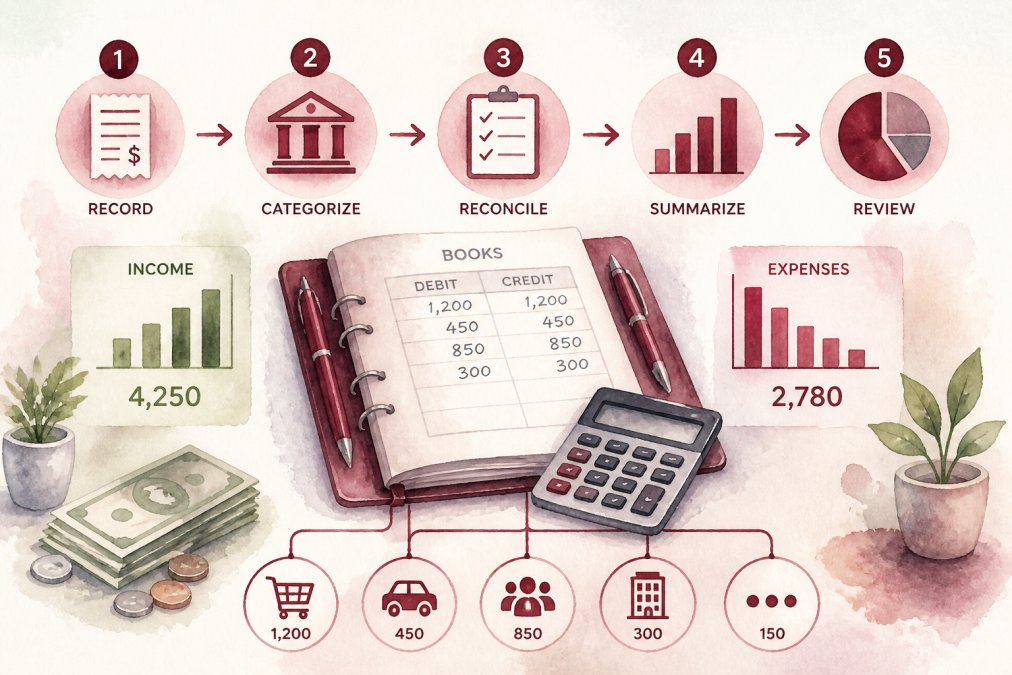
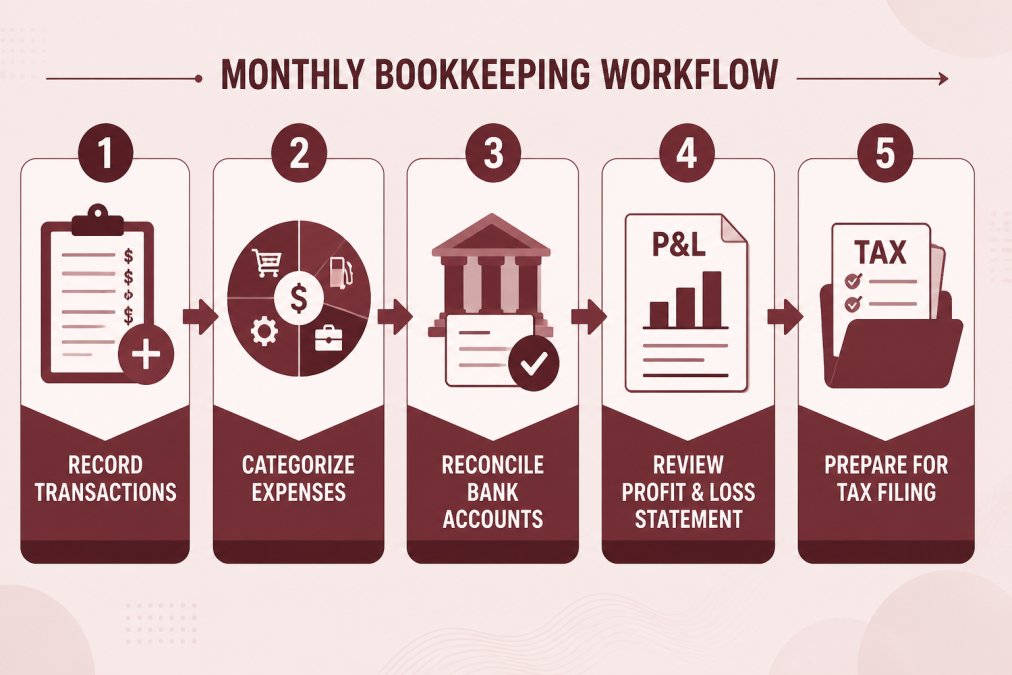
A bookkeeping checklist keeps you on track and prevents costly mistakes. The rhythm is monthly: record, categorize, reconcile, review. This cycle takes most small business owners two to four hours per month.
Week 1: Record Transactions Gather receipts, invoices, and bank statements. Enter each transaction into your system with the date, amount, and category. Many tools can import bank transactions automatically.
Week 2: Categorize and Reconcile Review each transaction and ensure it's in the right category. Reconcile your bank account by comparing your records to your actual bank statement. This catches errors early.
Week 3: Review Reports Run a profit and loss statement to see if you made money that month. Check your bank balance against your records and flag unusual transactions.
Week 4: Prepare for Taxes Organize receipts for large expenses and flag any transactions you're unsure about. Clean monthly records mean less scrambling at tax time.
Handle New York State Sales Tax Requirements
If you sell taxable goods or services in New York, you must collect and remit sales tax. Register online with the Department of Taxation and Finance before you start operating.
Sales tax rates vary by location within New York. Mamaroneck and Westchester County have a combined state and local sales tax rate that you must charge to customers on taxable items, then remit to the state quarterly or monthly depending on your filing frequency. Keep detailed records of all sales and the tax you collected. Your bookkeeping system should track this separately from regular income. Missing deadlines or underpaying can result in penalties.
How to Choose Business Entity for Tax Efficiency
The business entity you choose affects how much tax you pay and how much paperwork you handle. Your options are sole proprietorship, LLC, S-corporation, or C-corporation.
A sole proprietorship is the simplest: you and your business are one entity. You pay income tax on all profits and are personally liable for business debts. There's minimal paperwork but no liability protection and higher self-employment tax.
An LLC offers liability protection: creditors can't come after your personal assets. For tax purposes, an LLC can be taxed as a sole proprietorship, partnership, or corporation, offering flexibility that appeals to many small business owners.
An S-corporation allows you to split income between salary and distributions. You pay self-employment tax on your salary but not on distributions, which can save money if your business is profitable. The tradeoff is more paperwork and accounting costs.
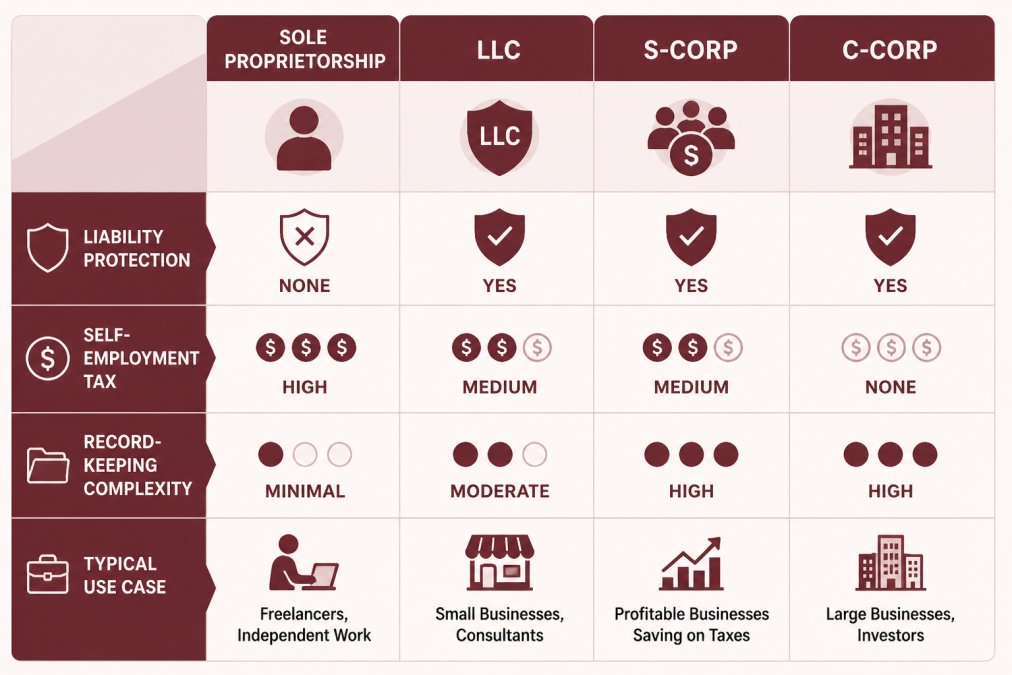
The right choice depends on your profit level, liability risk, and willingness to handle compliance. Many small business owners benefit from working with a tax advisor who can model the tax impact of each entity type.
Simple bookkeeping doesn't require a degree in accounting. It requires consistency, the right tools, and a monthly routine. If you're ready to simplify your financial processes and get clarity on your business's true performance, Paldino Company CPA helps small business owners and entrepreneurs in New York and Westchester County build bookkeeping systems that actually work. Schedule an Appointment to discuss how we can help you organize your finances and prepare for tax season with confidence.
Frequently Asked Questions
Q: What are the basic steps for simple bookkeeping for small business?
A: Start by setting up a system to track income and expenses daily. Record all transactions in accounting software or a ledger, categorize them by type, and reconcile your bank account monthly. At quarter-end and year-end, review your records to ensure accuracy before tax filing. The key is consistency, regular attention to bookkeeping prevents a chaotic year-end scramble.
Q: What should be on a bookkeeping checklist for small business?
A: Your checklist should include: recording daily sales and expenses, categorizing transactions, reconciling bank and credit card statements monthly, tracking invoices sent and received, monitoring accounts payable and receivable, and reviewing profit-and-loss reports quarterly. For businesses with sales tax obligations, add monthly or quarterly sales tax calculations and filing reminders based on your jurisdiction's requirements.
Q: How do I know if I've chosen the right business entity for tax purposes?
A: The right entity depends on your income level, liability concerns, and tax goals. A sole proprietorship is simplest but offers no liability protection. An LLC provides liability protection with flexible tax treatment. An S-Corp can reduce self-employment taxes if you earn substantial profit. Consult with a tax professional to evaluate your specific situation and ensure your entity choice aligns with your business structure and financial objectives.
This article was written using GrandRanker