 how-to
Tax Help for New Businesses: A 2026 Step-by-Step Guide
Table of Contents
- What You Need Before Filing New Business Taxes
- Business Structure and Tax Implications: LLC vs. S-Corp vs. Sole Prop
- Small Business Tax Deductions Checklist for Your First Year
- How to File Estimated Quarterly Taxes: Step-by-Step
- Federal Tax Forms, Deadlines, and Filing Requirements
- Best Tax Software for Small Business Owners
- Tax-Advantaged Retirement Planning for New Business Owners
- Common Tax Mistakes New Businesses Make (and How to Avoid Them)
Last Updated: August 3, 2026
Getting tax help for new businesses from day one is one of the most consequential decisions a founder makes, yet most first-time business owners discover the rules only after their first penalty notice. At Paldino Company CPA, we work with entrepreneurs across New York and Westchester County navigating this challenge. The same gaps come up repeatedly: missed deadlines, wrong business structures, and deductions left on the table. Below, we'll walk you through every critical tax obligation you'll face in your first year, from choosing your entity structure to filing your first quarterly payment.
According to IRS Small Business and Self-Employed Tax Center, new businesses must address federal tax registration, estimated tax payments, and employment tax obligations before they ever file their first annual return.
What You Need Before Filing New Business Taxes
Before you file anything, you need two foundational decisions locked in: your tax identification number and your accounting method.
Employer Identification Number and Filing Status
An Employer Identification Number is a nine-digit federal tax ID issued by the IRS that identifies your business as a distinct taxable entity, separate from your personal Social Security number. Even sole proprietors with no employees benefit from obtaining one, as it protects your SSN from exposure on vendor forms and bank applications.
Applying for an EIN is free and takes about 15 minutes online through the IRS website. Your filing status flows from your business structure: sole proprietors file Schedule C with Form 1040, partnerships file Form 1065, C-corps file Form 1120, and S-corps file Form 1120-S. Choosing the wrong filing status at registration forces an amendment later, costing both time and money.
Choosing Your Tax Year and Accounting Method
Most new businesses default to a calendar tax year running January 1 through December 31. A fiscal year can make sense if your revenue is heavily seasonal.
Your accounting method matters equally. Cash-basis accounting records income when you receive it and expenses when you pay them. Accrual accounting records transactions when earned or incurred, regardless of when cash moves. Once you choose, switching requires formal IRS approval. Make this decision before your first transaction.
Business Structure and Tax Implications: LLC vs. S-Corp vs. Sole Prop
Business structure is fundamentally a tax question, not just a legal one.
| Structure | Self-Employment Tax | Pass-Through Taxation | Complexity | Best For |
|---|---|---|---|---|
| Sole Proprietor | Full SE tax on all profits | Yes | Low | Freelancers, early-stage testing |
| Single-Member LLC | Full SE tax on all profits | Yes | Low-Medium | Liability protection with simplicity |
| S-Corp | SE tax on salary only | Yes | Medium-High | Profitable businesses above ~$50K net |
| C-Corp | No SE tax | No (double taxed) | High | Venture-backed startups |
Self-Employment Tax for Sole Proprietors
Self-employment tax is the combined Social Security and Medicare tax that sole proprietors and single-member LLC owners pay on their net business income. Your entire net profit is subject to self-employment tax, on top of ordinary income tax. As your business grows, this structure becomes increasingly expensive. The IRS allows you to deduct half of your self-employment tax when calculating adjusted gross income, providing partial relief but not changing the underlying math.
When an S-Corp Election Saves Real Money
An S-Corp election doesn't change how the business operates day to day. What it changes is how profits are distributed for tax purposes. As an S-Corp owner, you pay yourself a reasonable salary, which is subject to payroll taxes. Profits distributed above that salary are not subject to self-employment tax. In New York, state-level filing requirements add complexity, so this conversation is worth having with a CPA before you make the election.
Small Business Tax Deductions Checklist for Your First Year
The checklist below covers categories new business owners most commonly overlook. Every deduction reduces your taxable income directly.
- Home office deduction: calculated as a percentage of your home's square footage used exclusively for business
- Vehicle mileage: the IRS sets a standard mileage rate each year for business travel; keep a mileage log
- Business equipment and software: computers, phones, and subscriptions used for business purposes
- Professional services: accounting, legal, and consulting fees paid to run your business
- Health insurance premiums: self-employed individuals can often deduct 100% of premiums for themselves and their families
- Business meals: generally 50% deductible when directly related to business activity
- Education and training: courses, books, and certifications directly related to your current business
- Marketing and advertising: website costs, ad spend, and promotional materials
- Retirement plan contributions: SEP-IRA or Solo 401(k) contributions reduce taxable income significantly
A common mistake is treating personal expenses as business expenses. The IRS scrutinizes mixed-use items closely, and unsupported deductions in an audit trigger penalties on top of the tax owed.
How to File Estimated Quarterly Taxes: Step-by-Step
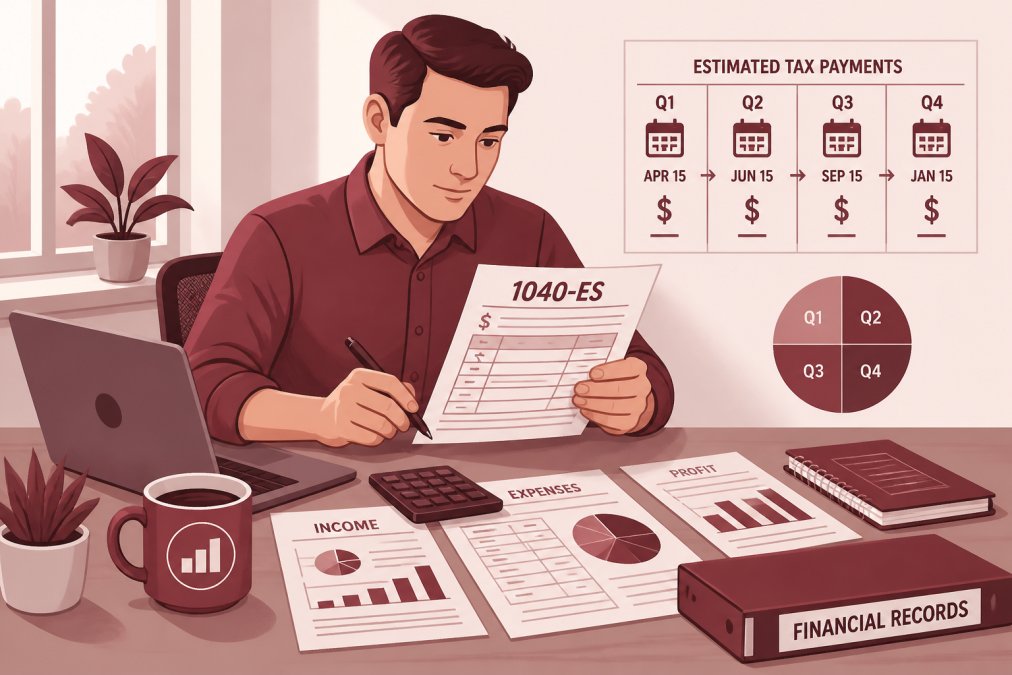
Filing estimated quarterly taxes is required for any business owner who expects to owe more than $1,000 in federal taxes for the year. Miss a payment or underpay, and the IRS charges an underpayment penalty on top of the tax owed.
Here's the step-by-step process for first-time filers:
- Estimate your annual net income. Start with projected gross revenue and subtract expected business expenses.
- Calculate your self-employment tax. Multiply your net profit by 92.35%, then apply the SE tax rate. Deduct half of this amount from your income.
- Apply your income tax rate. Add your estimated net profit to any other household income and apply the appropriate federal tax brackets.
- Divide by four. Your total estimated annual tax liability divided by four gives you your quarterly payment amount.
- Pay by the deadline. Use IRS Direct Pay or the Electronic Federal Tax Payment System to submit each payment.
Calculating Your Estimated Tax Liability
The IRS provides a safe harbor rule: if you pay either 100% of last year's tax liability or 90% of this year's actual liability, you avoid the underpayment penalty. For most new businesses with no prior year tax history, targeting 90% of this year's projected liability is practical. Track your income monthly and recalculate before each payment deadline if revenue changes significantly.
IRS Form 1040-ES and Payment Deadlines
IRS Form 1040-ES is used to calculate and submit estimated quarterly tax payments for individuals, including sole proprietors and single-member LLC owners. It includes a worksheet that walks you through the liability calculation.
The 2026 quarterly estimated tax deadlines are:
- Q1 (January-March): April 15, 2026
- Q2 (April-May): June 16, 2026
- Q3 (June-August): September 15, 2026
- Q4 (September-December): January 15, 2027
Mark these in your calendar now. There's no reminder system, and missing a deadline is entirely your responsibility.
Federal Tax Forms, Deadlines, and Filing Requirements
Federal tax compliance for new businesses involves more than one annual return. The forms you file depend on your business structure, whether you have employees, and how you've elected to be taxed.
According to IRS Publication 583 on starting a business, new business owners must keep records sufficient to prepare a complete and accurate tax return and to support any deductions or credits claimed.
Core forms by structure:
- Sole proprietors: Schedule C with Form 1040; annual deadline April 15
- Partnerships: Form 1065; deadline March 15
- S-Corps: Form 1120-S; deadline March 15
- C-Corps: Form 1120; deadline April 15
If you have employees, you're also responsible for quarterly payroll tax deposits using Form 941, annual W-2 filings, and FUTA tax reporting on Form 940. Payroll tax obligations don't pause because you're busy. The IRS treats payroll tax failures with particular severity, including personal liability for business owners. An extension to file is not an extension to pay, any tax owed is still due on the original deadline.
Best Tax Software for Small Business Owners
Tax preparation software has improved significantly, and many new business owners can handle straightforward returns themselves. The best tax software options for small business owners in 2026 include:
- TurboTax Business: Strong for S-Corps and partnerships, with guided interview-style filing and e-file capability
- H&R Block Premium and Business: Good for sole proprietors, with a solid home office deduction calculator
- TaxAct Business: Lower cost option for straightforward returns with basic support
- QuickBooks Tax: Integrates directly with QuickBooks bookkeeping, reducing data entry errors significantly
Tax-Advantaged Retirement Planning for New Business Owners
Retirement planning is one of the most overlooked forms of tax help for new businesses. Contributions to qualifying retirement accounts reduce your taxable income dollar for dollar.
Three main options are worth knowing:
SEP-IRA: A Simplified Employee Pension allows self-employed individuals to contribute a percentage of net self-employment income each year, up to the IRS annual limit. You can open and fund a SEP-IRA as late as your tax filing deadline, including extensions.
Solo 401(k): Available to self-employed individuals with no full-time employees other than a spouse, the Solo 401(k) allows both employee and employer contributions, resulting in a higher potential annual contribution ceiling than a SEP-IRA. It must be established by December 31 of the tax year you want contributions to apply.
SIMPLE IRA: Better suited for businesses with employees, the SIMPLE IRA requires employer matching contributions but allows employees to contribute as well.
The right choice depends on your income level, whether you have employees, and your cash flow flexibility. Model this decision with a CPA before year-end.
Common Tax Mistakes New Businesses Make (and How to Avoid Them)
Most tax problems for new businesses aren't caused by complexity. They're caused by avoidable oversights that compound over time.
The most common mistakes and their real consequences:
- Mixing personal and business finances: Using one bank account for both creates a documentation nightmare and weakens the legal separation that protects your personal assets. Open a dedicated business account before your first transaction.
- Missing estimated tax deadlines: The underpayment penalty accrues quarterly. Missing all four payments in a year adds up to meaningful additional cost beyond the tax itself.
- Misclassifying workers: Treating employees as independent contractors to avoid payroll taxes is one of the most scrutinized areas in IRS enforcement. The classification test is based on the actual working relationship, not what you call it.
- Failing to track mileage and receipts in real time: Reconstructing a year's worth of business expenses from memory doesn't hold up in a tax audit. Use an app or spreadsheet from day one.
- Ignoring state and local tax obligations: Federal compliance is only part of the picture. New York State has its own income tax, and New York City imposes a separate business income tax. Westchester County businesses may face additional local requirements.

The pattern most often seen: a new business owner files their first return correctly but hasn't tracked deductions properly all year, so they overpay significantly. The real cost was invisible. As SCORE's small business tax guide notes, proactive recordkeeping and quarterly check-ins with a tax professional are the most effective ways to avoid costly surprises at filing time.
Tax compliance for a new business has moving parts that don't wait for you to feel ready: quarterly deadlines, payroll obligations, entity elections with hard cutoff dates, and state-level requirements layered on top of federal ones. Paldino Company CPA provides year-round tax support, not just annual filing, so you're not discovering problems after the deadline has passed. Led by Joe Paldino, the firm combines professional precision with a genuinely human-centered approach to help New York and Westchester County entrepreneurs get the financial clarity they need to grow with confidence. Schedule an appointment with Paldino Company CPA and get a tax strategy built around your actual business, not a generic checklist.
Frequently Asked Questions
Do I get a tax break for starting a new business?
Yes. The IRS allows new businesses to deduct up to $5,000 in startup costs and $5,000 in organizational costs in their first tax year, provided total startup expenses are under $50,000. Costs above those thresholds must be amortized over 180 months. Eligible expenses include market research, legal fees, and advertising before opening. Keeping detailed records from day one is essential to claim these deductions accurately on your tax return.
Do I need to pay estimated quarterly taxes as a new business owner?
Most likely, yes. If you expect to owe $1,000 or more in federal taxes for the year and your withholding won't cover it, the IRS requires quarterly estimated tax payments. This applies to sole proprietors, LLC members, and S-Corp shareholders who take distributions. Payments are made using IRS Form 1040-ES, with due dates typically in April, June, September, and January. Missing these deadlines can result in underpayment penalties, so tracking your taxable income throughout the year matters.
What are the most common tax deductions for new small businesses?
Common write-offs for new businesses include home office expenses, business vehicle mileage, health insurance premiums for self-employed owners, software subscriptions, professional fees, advertising costs, and startup expenses. Under Section 179, you can also deduct the full cost of qualifying equipment purchased and placed in service during the tax year. A small business tax deductions checklist helps ensure you capture every eligible expense before filing and reduces your overall tax liability.
How do I choose the right business structure for tax purposes?
Your business structure directly affects how much self-employment tax you pay and what forms you file. A sole proprietor reports income on Schedule C and pays self-employment tax on all net profits. An LLC taxed as an S-Corp can split income between salary and distributions, potentially reducing self-employment tax exposure. The right choice depends on your revenue level, growth plans, and filing complexity. A CPA familiar with new business taxes can model the difference and help you decide before your first tax year ends.
What tax software works best for small business owners?
Popular options include TurboTax Business, H&R Block Premium & Business, and TaxAct Business, each of which supports Schedule C, Schedule E, and corporate returns. QuickBooks Self-Employed integrates bookkeeping with tax prep and exports directly to TurboTax. For businesses with employees or more complex structures, professional tax preparation software used by a CPA typically offers greater accuracy and audit protection. Software costs and capabilities vary, so match the tool to your entity type and transaction volume before committing.
When are small business taxes due in the United States?
For sole proprietors and single-member LLCs, the annual tax return is due April 15. S-Corps and partnerships file by March 15. Quarterly estimated tax payments are generally due April 15, June 16, September 15, and January 15 of the following year. Payroll tax deposits follow their own schedule based on payroll size. If a deadline falls on a weekend or federal holiday, it shifts to the next business day. Extensions are available but only extend the filing deadline, not the payment deadline.
This article was written using GrandRanker