 How-to
7 Tax Implications of Changing Business Structure
Last Updated: October 24, 2026
Quick Summary
Changing your business structure affects federal taxes mainly through how the IRS taxes profit: sole proprietors pay self-employment tax on all earnings, S corporations split income into salary and distributions, and C corporations pay entity-level tax before shareholders pay again on dividends. You also file a final return for the old entity and usually need a new EIN.
- An S corporation election keeps the LLC's legal form but changes how the IRS taxes its profit.
- The IRS requires reasonable compensation for S corporation shareholder-employees, so a salary far below market invites scrutiny.
- Most LLCs must file Form 2553 by March 15 for the S election to take effect that year.
- A statutory conversion or contribution to a new corporation may qualify for tax-free treatment if the requirements are met.
- File final returns for the old entity and keep records of every filing and effective date.
Table of Contents
- How Changing Business Structure Affects Federal Taxes
- LLC to S Corporation Tax Implications
- LLC to C Corporation Conversion Tax Consequences
- Your Business Entity Conversion Checklist
- Frequently Asked Questions
How Changing Business Structure Affects Federal Taxes
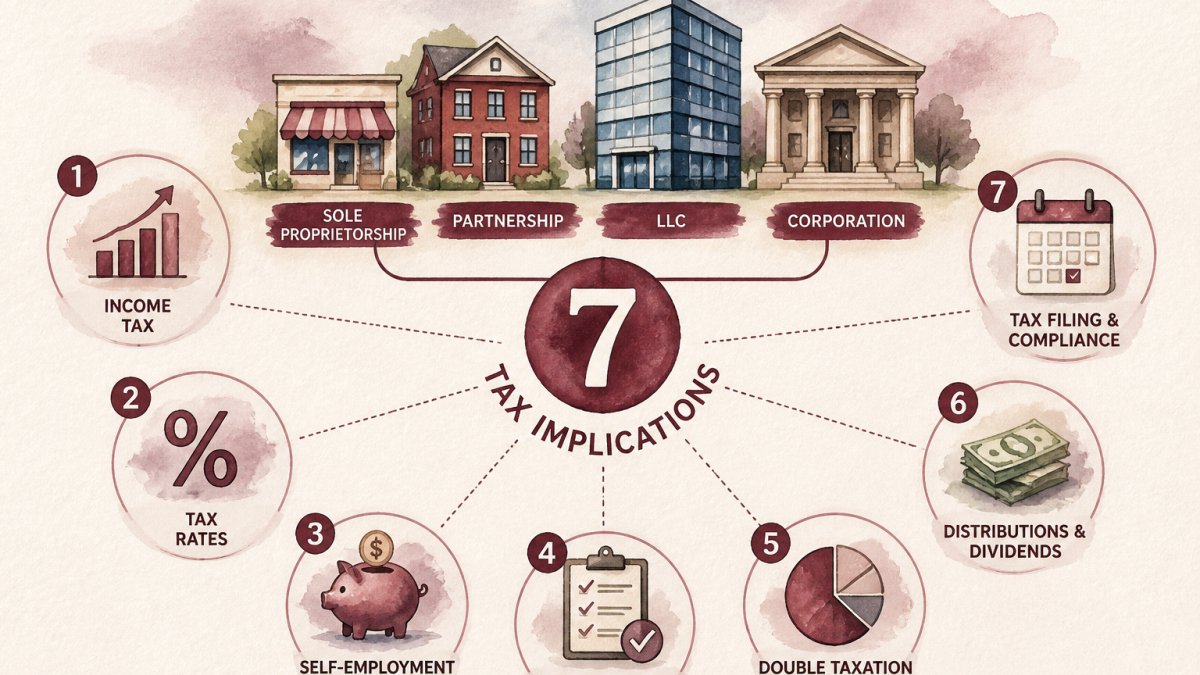
The tax implications of changing business structure come down to how the IRS taxes profit: sole proprietors pay self-employment tax on all earnings, S corporations split income into salary and distributions, and C corporations pay entity-level tax before shareholders pay again on dividends.
At Paldino Company CPA, we walk Mamaroneck business owners through this decision every year. Your business structure touches your federal return, state filings, and personal liability; switch and you file a final return for the old entity, apply for a new EIN in most cases, and adopt a new tax year and accounting method.
Three federal rules drive most of the difference: self-employment tax on sole proprietors and general partners, pass-through treatment for S corporations and partnerships, and double taxation for C corporations. The IRS guide to business structures lays out the default classifications; the rest is planning.
For owners weighing a fresh start, our small business start-up in Westchester County service covers entity selection from day one, and this piece on how corporate and LLC structure can protect a sole proprietor's assets explains what a change shields.
LLC to S Corporation Tax Implications
An S corporation election changes how the IRS taxes an LLC's profit, not who owns it: the LLC keeps its legal form, but the IRS treats it as a pass-through corporation, splitting profit into reasonable salary and distributions.
Watch out: the IRS requires "reasonable compensation" for shareholder-employees, so a salary far below market invites scrutiny. The IRS instructions for Form 2553 cover the election and its deadline; it needs unanimous shareholder consent, most LLCs must file by March 15 to take effect that year, state treatment can differ from federal, and you must run formal distributions rather than informal draws.
Our S-corporation tax and accounting services cover the election, reasonable-salary analysis, and ongoing filings.
LLC to C Corporation Conversion Tax Consequences
A C corporation pays its own federal income tax, then shareholders pay again on dividends, the trade-off for a structure investors understand and that can issue multiple share classes.
Conversion raises two questions: does the change trigger gain recognition, and what happens to the old entity's final year? A statutory conversion or contribution to a new corporation may qualify for tax-free treatment if the requirements are met; the IRS publication on corporate contributions explains when a transfer avoids gain, and getting this wrong lands the tax bill on the conversion itself.
Also file a final return for the LLC or partnership, confirm the new corporation's tax year and accounting method, update state and local registrations, and review owner compensation and fringe benefits under corporate rules. Our corporate tax team handles the conversion mechanics and first corporate return, and our Mamaroneck, New York business consulting service covers the operating side.
Your Business Entity Conversion Checklist
Work through these in order, skipping one usually means a penalty or refiling later: confirm the tax election and file the right IRS form, obtain a new EIN, update state and local registrations including New York sales tax accounts, notify your bank, insurers, and lenders, file final returns for the old entity, and keep records of every filing and effective date.
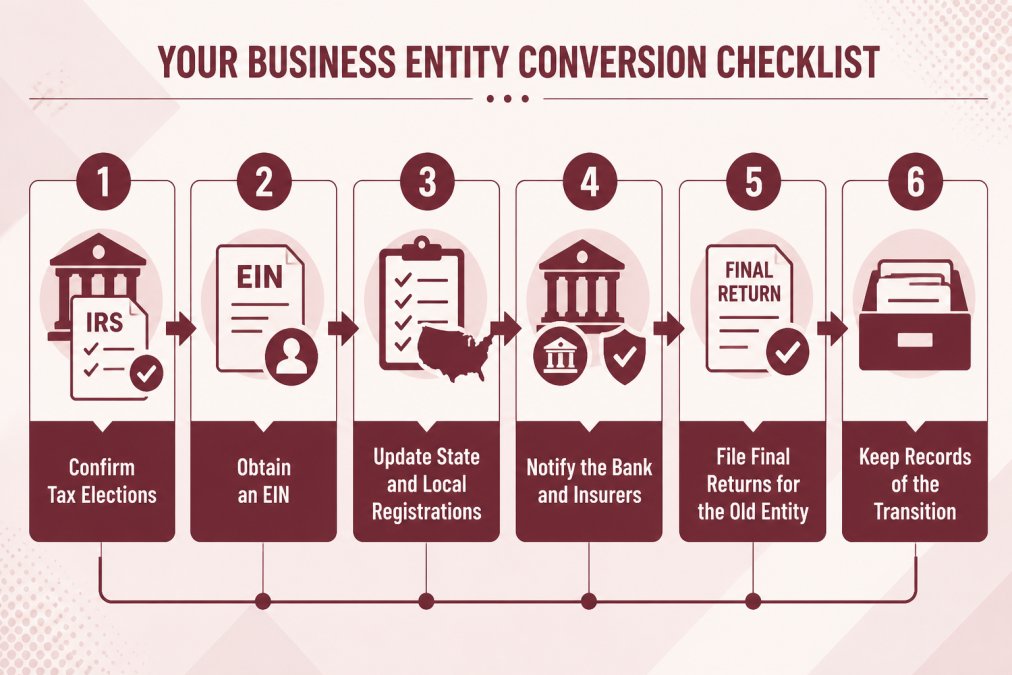
Timing matters more than the list: most elections and effective dates line up with the tax year, so a missed deadline can push the whole change into the following year.
| Structure Change | Main Federal Tax Effect | Key Form or Step |
|---|---|---|
| Sole prop to LLC | Same default tax treatment unless an election is filed | No new EIN required in many cases |
| LLC to S corp | Pass-through with salary and distributions split | Form 2553 |
| LLC to C corp | Entity-level tax plus shareholder tax on dividends | New EIN, final LLC return |
| Partnership to corporation | Possible gain on contributed assets | Contribution rules apply |
Frequently Asked Questions
Does changing from an LLC to a corporation trigger taxes?
It can. An LLC taxed as a partnership or sole proprietorship that converts to a C corporation may face tax on built-in gains if the LLC's assets are worth more than their tax basis. An S corporation election is often treated differently, but the IRS scrutinizes the transaction. The outcome depends on your entity type, asset values and elections, so review the move with a CPA before filing.
What tax filings are required when a business changes its structure?
Expect to file a final return for the old entity, obtain a new EIN if the structure changes, and update state and local registrations. An S corporation election requires IRS Form 2553 within the allowed window. A business entity conversion checklist helps you track these steps so no filing or deadline is missed during the transition.
Should I consult a CPA before changing my business structure?
Yes. The tax implications of changing business structure depend on your income, asset values and long-term plans, and a wrong election can create avoidable tax. A CPA can model the outcomes, confirm which IRS forms apply and coordinate the filings. If you are in Westchester County, schedule a review with a local firm before you sign any conversion documents.
Changing structure is a tax decision and a timing decision at once. Get the election date wrong and the savings disappear. Paldino Company CPA helps owners sort the reasonable-salary question, the conversion filings, and the year-round bookkeeping that keeps the new entity clean, with virtual CFO support and year-round tax help built for small businesses. Get started with Paldino Company CPA and make the switch with a clear plan instead of a guess.