 listicle
Tax Planning Strategies for NYC Freelancers
Table of Contents
- Understand Your Self-Employment Tax Obligations
- How to Choose Business Entity for Freelancers
- Deductible Business Expenses for Independent Contractors
- Unincorporated Business Tax (UBT) Explained
Last Updated: August 17, 2026
Understand Your Self-Employment Tax Obligations
Self-employment tax is the Social Security and Medicare tax that freelancers and independent contractors must pay on their net business income. Unlike traditional employees who split these taxes with their employer, self-employed individuals pay the full amount: 15.3% combined (12.4% for Social Security on earnings up to a cap, and 2.9% for Medicare on all earnings).
The IRS requires you to file Schedule SE with your tax return to calculate what you owe. If you earn $50,000 in net self-employment income, you're looking at roughly $7,065 in self-employment taxes alone, before any income tax obligation. Understanding this obligation early shapes everything else in your tax planning, it determines whether quarterly estimated payments make sense, influences which business entity you should choose, and affects how much you need to set aside each month. Self-employment tax applies to your net income after deductible business expenses, not your gross revenue.

How to Choose Business Entity for Freelancers
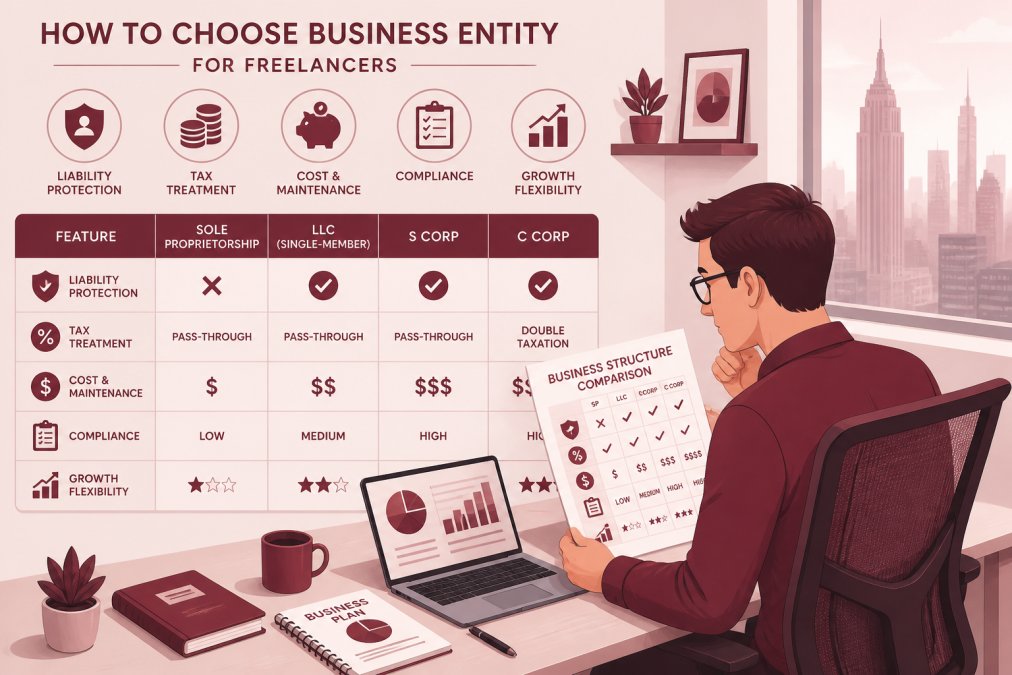
The business entity you select determines your tax liability, personal liability protection, and administrative burden. For freelancers, the three main options are sole proprietorship, LLC, and S-Corp election.
Sole Proprietorship is the default if you do nothing. You report income on Schedule C and pay self-employment tax on all net profits with no liability protection. It's simple but expensive from a tax perspective for anyone earning meaningful income.
LLC Formation provides liability protection and flexibility. You file Articles of Organization with your state (in New York, this costs around $25 plus filing fees through services like ZenBusiness for New York LLC formation). An LLC taxed as a sole proprietor still pays self-employment tax on all net income, so the tax burden doesn't change unless you elect S-Corp taxation.
S-Corp Election is where tax planning gets interesting. By electing S-Corp status on Form 2553, you split your income into salary and distributions. You pay self-employment tax only on the salary portion, not on distributions. This creates significant savings if your net profit exceeds $60,000 annually. The tradeoff: you must pay yourself a "reasonable salary" for the work you perform, file additional tax forms, and handle payroll processing.
For most NYC freelancers earning under $80,000 annually, sole proprietorship or a simple LLC makes sense. Above that threshold, an S-Corp election typically saves more in self-employment taxes than the added complexity costs.
Deductible Business Expenses for Independent Contractors
The qualified business income (QBI) deduction allows eligible self-employed individuals to deduct up to 20% of their business income, but only if you're tracking legitimate business expenses properly.
Common deductible expenses include home office costs (if you use a dedicated space), equipment and software subscriptions, professional development, business insurance, client acquisition costs, and vehicle expenses. Home office deduction offers two methods: simplified ($5 per square foot up to 300 square feet) or actual expenses (mortgage interest, utilities, insurance, repairs prorated to your office space). Vehicle expenses can be claimed using the standard mileage rate or actual expenses, requiring a contemporaneous log showing date, destination, business purpose, and miles driven.
Professional services, accounting, legal, consulting, and software subscriptions for your business are fully deductible. Continuing education in your field is deductible. Client entertainment is not (the deduction was eliminated in 2018).
Track everything throughout the year using accounting software like QuickBooks Self-Employed for freelance expense tracking. Real-time tracking makes tax filing infinitely easier than scrambling to reconstruct expenses in March.
Master Quarterly Estimated Tax Payments
Quarterly estimated tax payments are mandatory if you expect to owe more than $1,000 in taxes for the year. These payments are due April 15, June 15, September 15, and January 15 (for the following year). The IRS imposes penalties and interest if you underpay.
Most freelancers use the safe harbor method: pay 100% of last year's total tax liability (or 110% if your prior year income exceeded $150,000) divided into four quarterly payments. This ensures you won't face penalties even if your current year income increases. If business is slower than expected, you can reduce later payments. If it's booming, increase them. Failing to pay quarterly estimates triggers penalties, typically around 8% annually on underpaid amounts.
Unincorporated Business Tax (UBT) Explained
New York City imposes an additional tax on unincorporated businesses: the Unincorporated Business Tax (UBT). This is a city-specific obligation that many freelancers miss entirely until they receive a notice from the NYC Department of Finance.
The UBT applies to net income from self-employment if your net earnings exceed $4,000 in a tax year. The tax rate is 3.876% of net business income. For a freelancer earning $60,000 in net profit, the UBT adds roughly $2,326 to their annual tax bill. The UBT applies to sole proprietors and partnerships. If you elect S-Corp status, the UBT applies only to the salary portion you pay yourself, not to corporate distributions. This is another reason S-Corp election becomes attractive for higher-earning NYC freelancers.
Filing and payment happen alongside your federal and state tax returns via Form NYC-202. Quarterly estimated payments for UBT are also required if you expect to owe more than $100 for the year. According to NYC Department of Finance guidance on Unincorporated Business Tax, the UBT is one of the most commonly overlooked obligations for freelancers.
Tax planning for NYC freelancers requires layering federal self-employment tax, federal income tax, New York State income tax, and NYC's Unincorporated Business Tax into a coherent strategy. The right business entity, disciplined expense tracking, and timely quarterly payments reduce what you owe. Working with a tax professional who understands the NYC-specific landscape, like Paldino Company CPA, which specializes in helping freelancers and small business owners navigate these exact complexities, transforms tax season from a source of stress into a predictable, manageable process. Get started by scheduling a consultation to review your current structure and identify where you might be leaving money on the table.
| Strategy | Applies To | Key Benefit | Complexity |
|---|---|---|---|
| Sole proprietorship | All freelancers (default) | Simplest to set up | Higher self-employment tax |
| LLC formation | Freelancers seeking liability protection | Shields personal assets | Minimal tax benefit unless S-Corp elected |
| S-Corp election | Freelancers earning $60K+ net profit | Reduces self-employment tax on distributions | Requires payroll processing and additional filings |
| Expense tracking | All business entities | Reduces taxable income and qualifies for QBI deduction | Requires disciplined documentation |
| Quarterly estimated payments | Freelancers expecting $1,000+ tax liability | Avoids penalties and interest | Requires accurate income forecasting |
| UBT awareness | NYC-based freelancers earning $4,000+ | Prevents back taxes and penalties | NYC-specific compliance requirement |
Frequently Asked Questions
What specific taxes do freelancers need to pay?
Freelancers owe federal income tax on their net profit, self-employment tax (Social Security and Medicare), and state and local income taxes. Self-employment tax covers both employer and employee portions of Social Security and Medicare, typically around 15.3% of net profit. You'll report income on Schedule C and self-employment tax on Schedule SE. If you operate in New York, you may also owe Unincorporated Business Tax depending on your income threshold. Quarterly estimated tax payments help you stay current throughout the year and avoid penalties.
How does the Unincorporated Business Tax (UBT) affect independent contractors?
The Unincorporated Business Tax is a local tax imposed on business income earned by unincorporated entities operating in New York. The tax rate depends on your business income level, with higher rates applying to higher income brackets. If your net profit exceeds certain thresholds, you must file and pay UBT annually. UBT applies to sole proprietors and partnerships but not to corporations or LLCs taxed as corporations. Understanding your UBT liability is critical for accurate tax planning and cash flow management as a NYC-based freelancer.
Can I deduct home office expenses if I work from a rental apartment?
Yes, you can deduct home office expenses even if you rent. You can use either the simplified method (claiming $5 per square foot, up to 300 square feet) or the actual expense method. With actual expenses, you deduct a percentage of rent, utilities, internet, office supplies, and home maintenance based on the percentage of your home used for business. Keep detailed records and measure your dedicated office space. However, verify your lease allows business use, and consult a tax professional about any implications for your rental agreement or tax situation.
How often should I make estimated tax payments to avoid penalties?
Quarterly estimated tax payments are due on April 15, June 15, September 15, and January 15 of the following year. You calculate estimated tax based on your projected annual income, self-employment tax, and other tax liability. Missing payments or underpaying can result in IRS penalties and interest. If your income varies significantly throughout the year, you may adjust quarterly payments using Form 1040-ES. Many freelancers find it helpful to set aside 25-30% of income monthly to cover all tax obligations, then make quarterly deposits to stay on schedule.
What tax deductions should independent contractors prioritize?
Key deductions include home office expenses, business supplies, equipment (with depreciation rules), vehicle mileage for business trips, professional development and training, software and subscriptions, health insurance premiums, and retirement contributions. You can also deduct portions of internet, phone, and utilities if used for business. Keep organized records with receipts and mileage logs. The Qualified Business Income (QBI) deduction may allow you to deduct up to 20% of qualified business income, providing additional tax relief. Working with a tax professional helps ensure you capture all eligible deductions specific to your industry.
This article was written using GrandRanker