 listicle
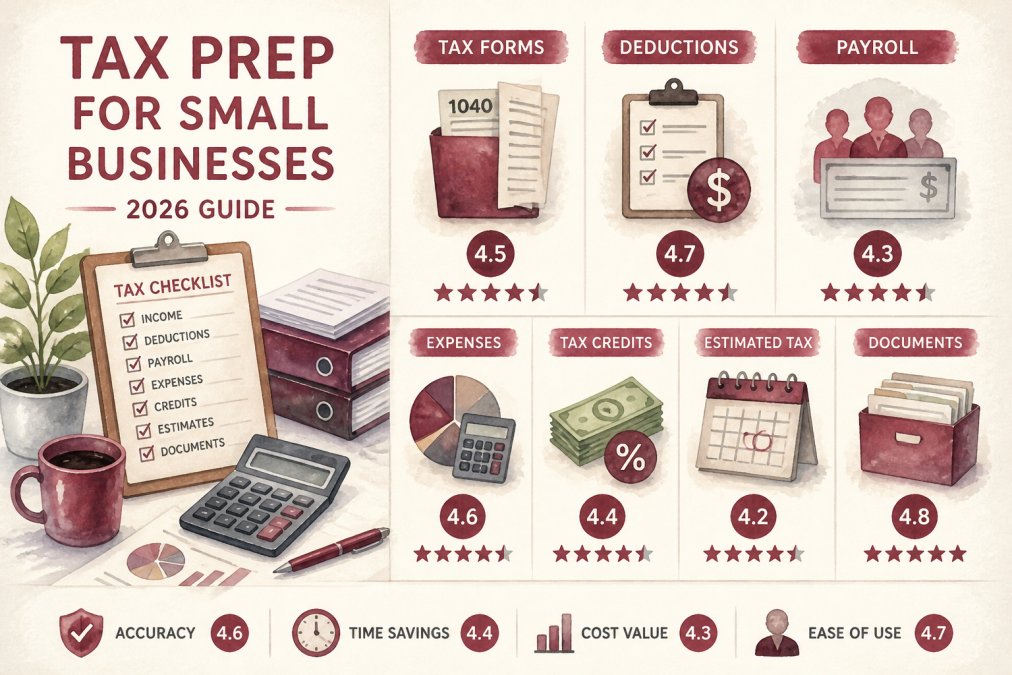
Tax Prep for Small Businesses: 2026 Guide
Table of Contents
- Tax Prep for Small Businesses: Software vs. Professional Services
- CPA vs. Tax Software for Small Business: Making the Right Choice
- Small Business Tax Deductions Checklist: What You Can Write Off
- How to Organize Business Expenses for Taxes
Last Updated: August 28, 2026
Tax Prep for Small Businesses: Software vs. Professional Services
Tax preparation for small businesses requires a strategic choice: handle it yourself with software, or partner with a professional CPA. The decision hinges on your business structure, complexity, and budget. At Paldino Company CPA, we help small business owners understand what's actually involved in tax prep for small businesses so you can make the choice that fits your situation.
A missed deduction costs you money. A filing error invites scrutiny. An incorrect entity classification can trigger thousands in back taxes and penalties (irs.gov). Below, we break down the tradeoffs between DIY tax software and professional services, walk through the deductions you can actually claim, and show you how to organize expenses so tax time isn't a nightmare.
CPA vs. Tax Software for Small Business: Making the Right Choice
A CPA brings human judgment, audit defense, and year-round strategy. Tax software brings speed, lower cost, and control. The right choice depends on your business structure, revenue, and risk tolerance.
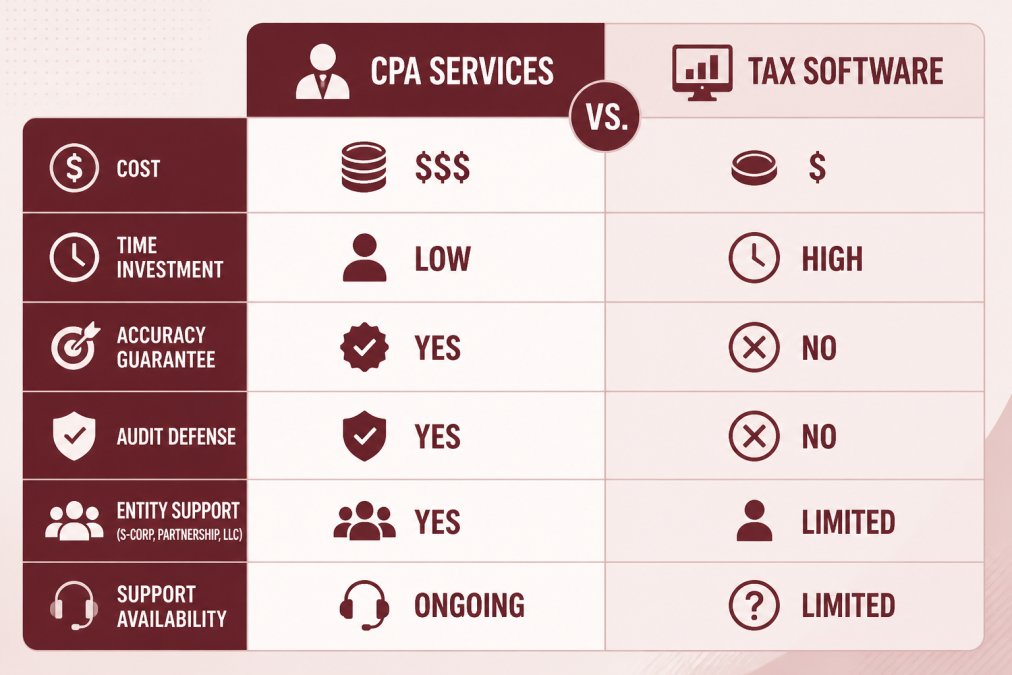
DIY tax software works best when:
- Your business structure is straightforward (sole proprietorship or single-member LLC)
- Revenue stays under $250K annually
- You have clean, organized expense records
- You're comfortable navigating forms and tax codes
QuickBooks Self-Employed ($15/month) handles basic Schedule C filing for freelancers. TurboTax Business ($170+ federal filing) supports S-corps and partnerships. TaxAct Business ($109.99 for sole proprietors, $149.99+ for partnerships) offers similar features at lower cost. The tradeoff: you own the accuracy risk.
Professional CPA services work best when:
- Your business structure is complex (S-corp, partnership, multi-member LLC)
- Revenue exceeds $250K or involves multiple income streams
- You face industry-specific tax rules
- You want audit defense and year-round tax planning
A CPA identifies deductions you'd miss, structures your business for tax efficiency, and builds a defense record if the IRS questions your return. Paldino Company CPA combines professional precision with year-round support so you're never scrambling at deadline. The firm specializes in helping creative professionals, freelancers, and small business owners understand their true tax liability and plan accordingly.
| Approach | Best For | Cost Range | Time Investment | Audit Support |
|---|---|---|---|---|
| DIY Software | Simple structures, under $250K revenue | $15-$170 | 8-20 hours | None |
| CPA Firm | Complex structures, over $250K revenue | Custom quote | 2-4 hours (you) | Full defense |
Small Business Tax Deductions Checklist: What You Can Write Off
Many small business owners leave money on the table because they don't know what qualifies as a deductible business expense. The IRS allows deductions for ordinary and necessary business expenses, but requires documentation.
Office and workspace: Home office deduction (dedicated space used exclusively for business), rent or mortgage interest, utilities, internet, phone (business portion only), and office furniture and supplies.
Transportation and travel: Mileage for business trips (track date, destination, purpose, miles), vehicle maintenance and fuel (if you track business use percentage), airfare and hotels, meals during business travel (50% deductible), and parking and tolls.
Professional services and tools: Accounting and bookkeeping software (QuickBooks, Wave, Xero, FreshBooks), CPA fees and tax preparation costs, legal consultation, and industry-specific software.
Payroll and contractor costs: Wages and salaries, contractor payments (1099 recipients), payroll processing fees, and employee benefits.
Marketing and advertising: Website design and hosting, social media advertising, business cards, and professional photography.
Insurance and licenses: Business liability insurance, professional licenses and permits, and health insurance premiums (self-employed).
Meals and entertainment: Client meals (50% deductible) and business conference meals (irs.gov).
The key: keep receipts and document the business purpose. A meal expense without a note about who you met and why gets disallowed. A mileage deduction without a log gets questioned. Documentation transforms a deduction from a guess into a defensible claim.
How to Organize Business Expenses for Taxes
Disorganized expenses create two problems: you miss deductions, and you can't defend the ones you claim. A simple system prevents both.
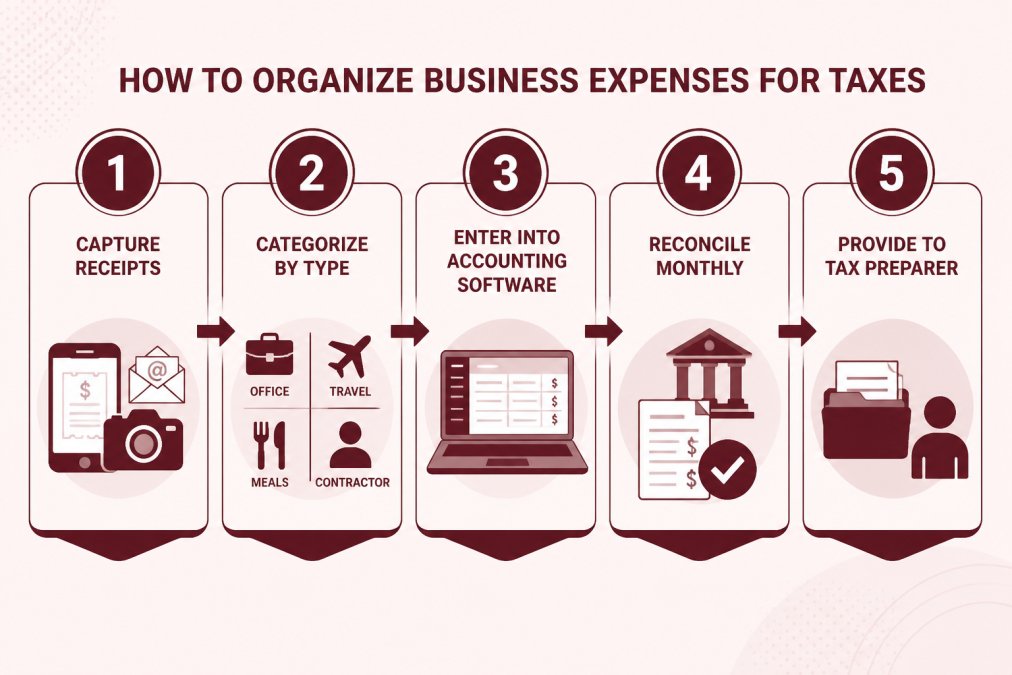
Step 1: Capture receipts immediately. Take a photo of paper receipts the day you incur the expense. For digital purchases, save the email confirmation or download the receipt as a PDF.
Step 2: Categorize consistently. Create categories that match your tax form (Schedule C for sole proprietors, Form 1120-S for S-corps) (irs.gov). Consistency matters more than perfection.
Step 3: Enter into accounting software. QuickBooks, Wave, or Xero let you upload receipts, assign categories, and track spending by month. Link your business bank account so transactions auto-populate.
Step 4: Reconcile monthly. Spend 15 minutes at month-end matching your software entries to your bank statement. This catches errors while memory is fresh and provides a clean ledger if audited.
Step 5: Hand off organized records. Provide organized records to your CPA or tax software. This saves time and keeps costs lower.
Tax prep for small businesses doesn't have to be stressful. The right combination of organized systems and professional guidance ensures you claim every deduction you're entitled to and file with confidence. If your business is growing or your structure is complex, a CPA partnership like Paldino Company CPA's year-round support model pays for itself through deductions identified and tax strategies implemented. Start by organizing your expenses, then decide whether software or professional services fits your needs.
Frequently Asked Questions
What's the difference between DIY tax software and hiring a CPA for small business tax prep?
DIY tax software like TurboTax or QuickBooks Self-Employed walks you through filing step-by-step and costs $15-$170 upfront, but you handle everything yourself and may miss deductions or entity optimization. A CPA provides year-round guidance, identifies tax savings, handles filing, and can defend you in an audit, ideal if your business structure is complex or your tax liability is high. Software works best for sole proprietors with straightforward income; CPAs earn their value through strategy and peace of mind.
What business expenses can I deduct on my small business tax return?
Deductible business expenses include office supplies, equipment, rent or mortgage interest, utilities, vehicle mileage, meals and entertainment (50% deductible), professional services, insurance, and advertising. The key rule: the expense must be ordinary and necessary for your business. Keep receipts and categorize expenses clearly. A small business tax deductions checklist should be reviewed annually with a tax professional to ensure you're not missing category-specific write-offs tied to your industry.
How do I organize business expenses so my tax prep is accurate and efficient?
Use accounting software (QuickBooks, Wave, or Xero) to categorize expenses as they occur. Capture receipts digitally via photo or email immediately. Reconcile your bank and credit card accounts monthly to catch errors early. Separate business and personal accounts to avoid confusion. Create folders or spreadsheet tabs by expense type (travel, meals, office, payroll). Before tax season, provide your accountant with organized records, this reduces errors, speeds up filing, and may lower your tax prep costs.
This article was written using GrandRanker