
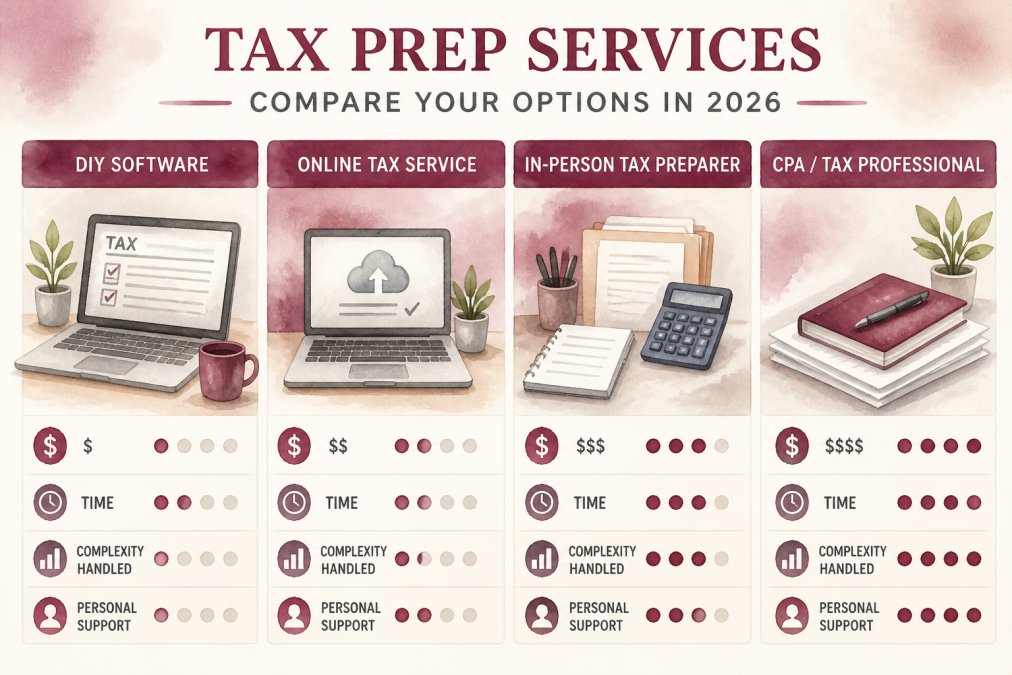
 comparison
Tax Prep Services: Compare Your Options in 2026
Table of Contents
- Tax Prep Services: What You're Choosing Between
- Comparison Table: Tax Prep Services at a Glance
- CPA vs Tax Preparer: Which One Do You Need?
- Small Business Tax Preparation Cost: What to Expect
Last Updated: August 21, 2026
Tax Prep Services: What You're Choosing Between
When tax season arrives, you face a fundamental choice: DIY software, a tax preparer, a CPA, or something in between. The decision shapes your filing experience, refund, and peace of mind. At Paldino Company CPA, we've seen clients struggle with this question, and the answer depends on your specific situation, not what's "best" in general.
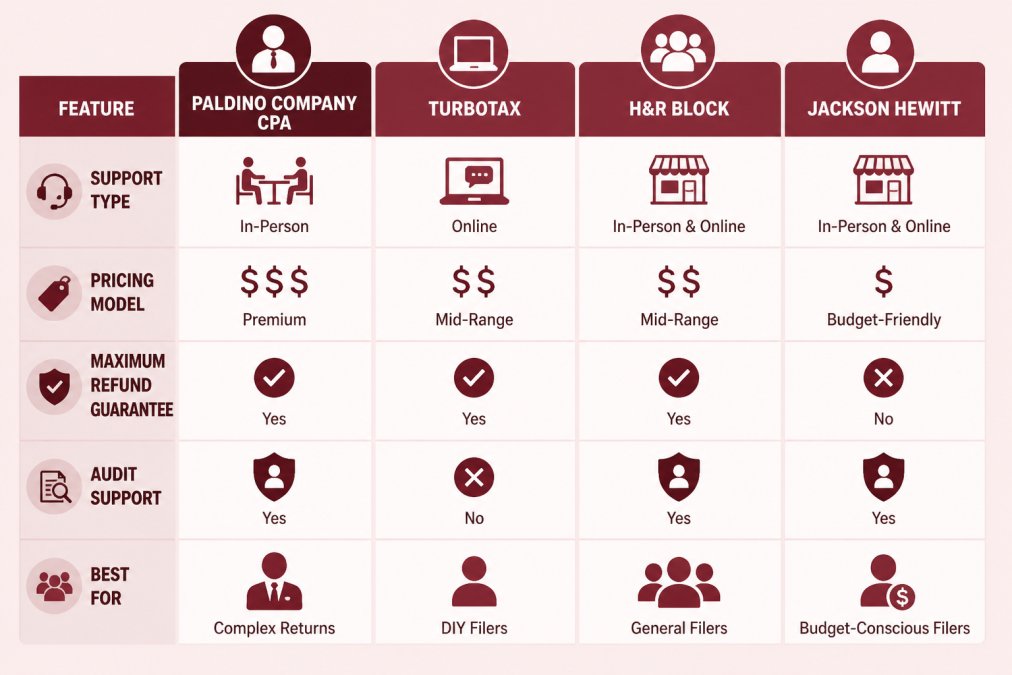
The landscape offers free filing for simple income, flat-fee online options, full-service professional preparation, and live expert support without full preparation. Each trades cost against convenience, control against expertise, and speed against accuracy. The wrong choice costs money through overpaid fees or missed tax reductions. The right choice ensures accuracy and confidence.
Comparison Table: Tax Prep Services at a Glance
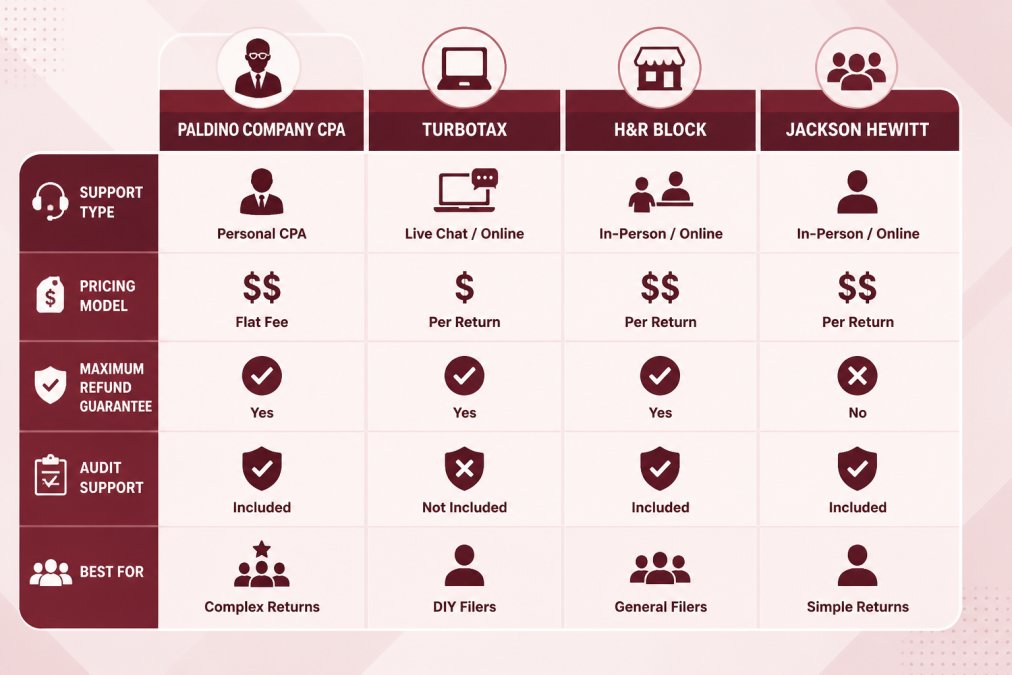
| Service | Support Type | Pricing Model | Maximum Refund Guarantee | Best For |
|---|---|---|---|---|
| Paldino Company CPA | Professional preparation and year-round advisory | Custom quote | Individuals and small businesses seeking personalized guidance | |
| TurboTax | DIY software with optional expert assistance | Free to $139 federal + state fees | Yes | Self-directed filers who want guided support |
| H&R Block | DIY software or in-person preparation | Free to $130 federal + state fees | Yes | Filers preferring flexible support options |
| Jackson Hewitt | Online filing or in-person service | $25 flat federal + unlimited state | Yes | Budget-conscious filers wanting transparency |
Price and service level move inversely: DIY software costs least but demands the most from you. Professional preparation costs more but handles complexity. Expert assistance with software splits the difference.
CPA vs Tax Preparer: Which One Do You Need?
A CPA holds a state license, has passed rigorous exams, and carries professional liability insurance (aicpa.org). A tax preparer may lack formal credentials. A CPA offers strategic tax planning beyond filing; a tax preparer typically handles filing itself.
For straightforward W-2 returns, a tax preparer suffices. A CPA's value emerges with complexity: self-employment, business ownership, significant investment income, or major financial moves. A CPA advises on entity structure, estimated quarterly payments, retirement contributions, and strategies to reduce tax liability over time.
A tax preparer files your taxes. A CPA helps structure your finances to pay less. For freelancers with inconsistent income, business owners, and anyone with multiple income sources, the strategic guidance typically justifies the additional cost.
Small Business Tax Preparation Cost: What to Expect
Small business tax preparation costs more than personal returns because complexity multiplies (sba.gov). You're tracking deductions, managing depreciation, handling payroll taxes if you have employees, and potentially filing multiple forms depending on business structure.
Cost varies dramatically by setup. A sole proprietor filing Schedule C might pay modestly more than a personal return. An LLC or S-corporation with employees and multiple income streams costs substantially more (irs.gov). Poor bookkeeping increases costs further since the preparer must reconstruct records.
Year-round professional relationships prevent expensive mistakes. Quarterly estimated tax payments, proper expense categorization, and strategic timing of business decisions reduce your final tax bill. Many small business owners discover they've overpaid taxes for years by missing deductions or strategies specific to their structure.
An audit triggered by poor record-keeping costs far more than professional preparation would have. The peace of mind from knowing a qualified professional reviewed your return is valuable when your business is your primary income source.
Choosing the right tax prep service means matching your situation to the right support level. Simple taxes and software comfort? DIY platforms work. Want professional guidance without full-service costs? Expert-assisted options bridge the gap. Complex finances or strategic planning needs? A CPA relationship pays for itself through tax reduction and peace of mind.
Paldino Company CPA specializes in personalized guidance for individuals and small businesses, offering year-round tax help, strategic planning, and business formation support. If you're uncertain whether your setup is optimized or missing deductions, a consultation clarifies what's possible for your situation. Schedule an appointment to explore how strategic tax planning could change your financial picture.
Frequently Asked Questions
Q: What is the difference between tax software and a CPA firm?
A: Tax software like TurboTax and H&R Block guides you through filing step-by-step, often with expert assistance options available for additional fees. A CPA firm like Paldino Company CPA provides personalized professional expertise, handles the entire filing process, and offers year-round strategic tax planning beyond annual filing. Software suits straightforward returns; CPAs work best for complex situations, business ownership, or ongoing financial guidance.
Q: When should you hire a professional for tax preparation?
A: Consider professional tax preparation if you have self-employment income, multiple income sources, significant investments, business deductions, or if you've faced IRS issues. Professionals also help if your situation changed (new business, marriage, major purchase) or if you want strategic tax planning to reduce liability for the upcoming year. Small business owners and creatives particularly benefit from professional guidance to ensure compliance and optimize deductions.
Q: What documents do I need to provide for tax preparation services?
A: Gather all W-2 forms from employers, 1099s for self-employment or contract income, records of estimated tax payments, mortgage interest statements, charitable contributions, medical expenses, and business expense records. Include prior-year tax returns and documentation of any major life changes. Organizing these documents before meeting with your tax preparer speeds up the process and ensures nothing is missed.
This article was written using GrandRanker