 blog
Outsourced Accounting vs Hiring a Full-Time Controller
Last Updated: November 18, 2026
Quick Summary
Outsourced accounting delivers controller-level oversight without recruiting burden and scales with transaction volume; it is 40% to 60% cheaper than a full-time hire once employment costs are included. A full-time controller gives daily presence and full close ownership, but it is a fixed commitment you cannot shrink in a slow quarter.
- Outsourced controller services run roughly $1,500 to $8,000 per month, while a full-time controller costs $120,000 to $180,000 annually.
- A full-time controller owns the monthly close, internal controls, financial statements, and the accounting team's day-to-day work.
- Choose outsourced support when workload is uneven, volume is climbing, or you need specialist expertise you cannot justify hiring for full-time.
- Paying an outside team to own the close after hiring a permanent controller duplicates responsibility and wastes money.
- Ask any provider how they handle permissions, who can see your general ledger, and how they protect your financial systems.
Table of Contents
- Outsourced Accounting vs Hiring a Full-Time Controller Pros and Cons
- Full-Time Controller Responsibilities and Accountant vs Controller
- When to Hire a Controller or Choose Outsourced Support
- Frequently Asked Questions
Outsourced Accounting vs Hiring a Full-Time Controller Pros and Cons
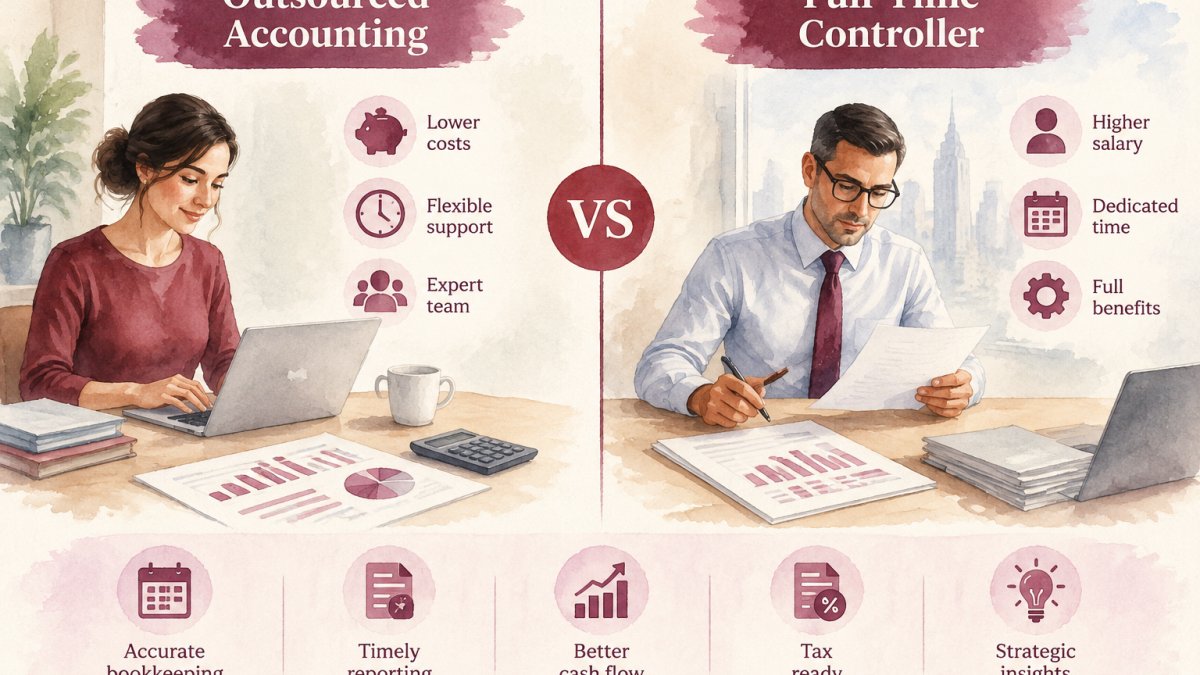
Outsourced accounting vs hiring a full-time controller is a trade: flexibility and lower fixed cost against daily, dedicated control. Outsourced controller services run roughly $1,500 to $8,000 per month, while a full-time controller costs $120,000 to $180,000 annually, per Jumpstart Partners' cost comparison.
| Factor | Outsourced Accounting | Full-Time Controller |
|---|---|---|
| Cost structure | Monthly fee, variable scope | Salary plus benefits and taxes |
| Control | Shared, remote oversight | Daily, on-site ownership |
| Scalability | Adjusts up or down quickly | Fixed commitment once hired |
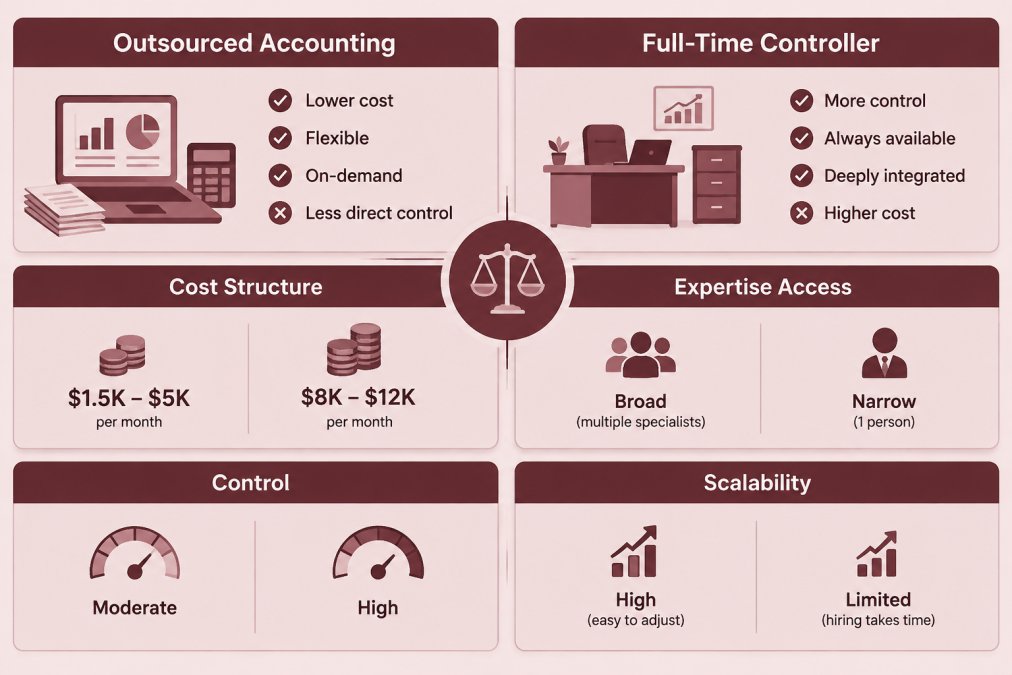
Outsourcing delivers controller-level oversight without recruiting burden and scales with transaction volume; it is 40% to 60% cheaper than a full-time hire once employment costs are included, per Predawn Accounting's outsourcing analysis. The cons: shared control, vendor dependence, and the need for an internal relationship owner. A full-time controller gives daily presence and full close ownership, but it is a fixed commitment you cannot shrink in a slow quarter. For what a hire truly costs beyond salary, see the real cost of hiring.
Full-Time Controller Responsibilities and Accountant vs Controller
A full-time controller owns the monthly close, internal controls, financial statements, and the accounting team's day-to-day work. The accountant versus controller distinction is scope: an accountant records and reconciles, while a controller designs the process, reviews output, and answers to leadership.
For advisory depth without a full-time salary, our business management consulting in New York pairs controller-level review with planning support.
When to Hire a Controller or Choose Outsourced Support
Hire a full-time controller for daily, dedicated coverage and direct control; choose outsourced support when workload is uneven, volume is climbing, or you need specialist expertise you cannot justify hiring for full-time. Outsourcing shines when you want bookkeeper, controller, and tax-preparer skill levels without hiring each role, as TaxDome's outsourcing guidance notes.
Watch out: paying an outside team to own the close after hiring a permanent controller duplicates responsibility and wastes money, a trap inDinero's handback guide describes.
If you are leaning toward outsourced support, our overview of scaling startup operations with virtual financial leadership shows how that model grows with you. For smaller operations, virtual bookkeeping services for small business cover the day-to-day layer, and our top-rated outsourced accounting services for startups outline what to expect.
Finally, ask any provider how they handle permissions, who can see your general ledger, and how they protect your financial systems.
The right choice depends on your workload, your growth stage, and how much control you want day to day. At Paldino Company CPA, we help Mamaroneck and Westchester County businesses sort through that decision with year-round support, virtual CFO services, and a human-centered approach that makes the numbers make sense. Get started with Paldino Company CPA and put controller-level clarity behind every financial decision.
Frequently Asked Questions
Is a controller higher than an accountant?
Yes. A controller sits above staff accountants and bookkeepers. Accountants handle day-to-day entries, reconciliations, and financial statement preparation, while a controller owns the monthly close, internal controls, management reporting, and compliance oversight. In smaller firms, the controller may also supervise the accounting team and coordinate with outside auditors. Understanding this hierarchy helps you decide whether you need basic accounting services or controller-level oversight.
Can outsourced accounting provide controller-level support?
Yes. Many outsourced accounting providers offer controller-level oversight, including monthly close management, financial statement review, budgeting, cash flow forecasting, and internal controls. This gives small businesses access to senior expertise without the cost of a full-time hire. The scope depends on the provider, so confirm what is included and how often you will have direct access to a controller.
When should a small business hire a full-time controller?
A full-time controller usually makes sense when transaction volume, reporting complexity, and staffing needs justify daily, dedicated coverage. Signs include a growing accounting team, frequent lender or investor reporting, and a need for tighter internal controls. If your workload is steady but not full-time, outsourced controller services can provide the same oversight on a flexible schedule.