 Ultimate guide
NYC Tax Rules for Remote Workers: A Mamaroneck Guide
Last Updated: November 12, 2026
Quick Summary
Under NYC tax rules, New York can tax your wages based on where your employer's office is located, not where you work remotely. The convenience-of-the-employer rule treats remote workdays as New York workdays unless your employer requires the remote work.
- New York treats you as a resident if domiciled there or you keep a permanent place of abode and spend more than 183 days.
- Keep a contemporaneous workday log, your employer's written remote-work policy, and any employer-directed work instructions.
- If your employer requires remote work, those days generally fall outside New York sourcing; if you chose it, they stay in.
- Most states offer a resident credit for taxes paid to another state, reducing but rarely eliminating double taxation.
- Start with your workday records, then your employer's written policy, then your filing position before you file.
Table of Contents
- The NY Convenience of the Employer Rule and Your Remote Work
- NYC Income Tax for Nonresidents and What Mamaroneck Residents Owe
- Live in NY, Work in CT Taxes: Credits, Double Taxation, and Home Office Deductions
- How Do You Determine Your Residency Status?
- What Records Should You Keep to Prove Business Necessity?
- Why Employer Business Necessity Changes Your Tax Sourcing
- How Do You Coordinate New York State, NYC, and Other-State Returns?
- What Should Mamaroneck Remote Workers Do First?
- Frequently Asked Questions
The NY Convenience of the Employer Rule and Your Remote Work
Navigating NYC tax rules for remote workers starts with one stubborn fact: under NYC tax rules, New York can tax your wages based on where your employer's office sits, not where your laptop sits. The convenience-of-the-employer rule treats a nonresident employee's remote workdays as New York workdays unless the employer requires the remote work, as the New York State Department of Taxation and Finance sets out in its guidance on the convenience of the employer rule.
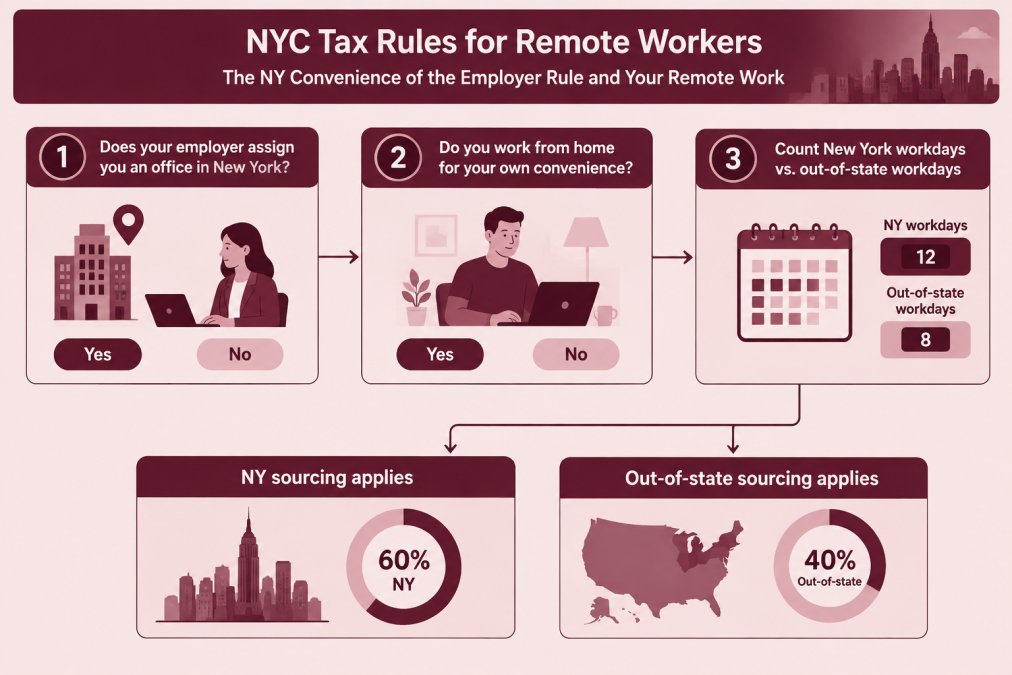
A home office does not automatically move your wages out of New York; to support business necessity, keep records of the arrangement, including any employer-directed work instructions and consistent workday records.
NYC Income Tax for Nonresidents and What Mamaroneck Residents Owe
New York City income tax generally applies to city residents, and nonresident treatment depends on the specific facts of your situation.
If you are a 1099 remote worker in Mamaroneck, our team offers tax and bookkeeping services for 1099 workers.
Live in NY, Work in CT Taxes: Credits, Double Taxation, and Home Office Deductions
Remote workers who split time between New York and Connecticut may owe tax to both states on the same wages. Most states offer a resident credit for taxes paid to another state, which reduces double taxation but rarely eliminates it; the New York State tax guidance on credits for taxes paid to other states explains how it is claimed. Keep your workday records and pay stubs, since the credit depends on documentation.
Employees generally cannot claim the federal home office deduction for convenience-of-the-employer work, while self-employed remote workers may qualify under IRS rules. Our overview of tax deductions for telecommuting employees covers which costs count, and the good and bad news about the home office tax deduction explains where the rules help.
Watch out: claiming a home office deduction for space you also use personally is a common audit trigger.
How Do You Determine Your Residency Status?
New York treats you as a resident if you are domiciled in the state or maintain a permanent place of abode and spend more than 183 days there in the tax year.
| Status | Key Test | Main Filing Obligation |
|---|---|---|
| NY resident | Domicile, or permanent place of abode plus 183+ days | Resident tax return on all income |
| NY nonresident | NY-source income only | Nonresident tax return |
| Part-year resident | Moved in or out during the year | Part-year return, split income |
| CT resident working in NY | Home state residency | CT return plus NY nonresident return |
Confirm your domicile, count your days in New York, check whether you keep a permanent place of abode, then apply the convenience rule to your workdays. Our article on how states are reshaping nexus laws for remote employees explains how these rules evolved.
What Records Should You Keep to Prove Business Necessity?
Keep a contemporaneous workday log showing where you worked each day, your employer's written remote-work policy, and any employer-directed work instructions. Store pay stubs and W-2s alongside the log so your wage allocation matches what your employer reported.
Why Employer Business Necessity Changes Your Tax Sourcing
If your employer requires you to work remotely, those days generally fall outside New York sourcing; if you chose to work remotely, they generally stay in. Get the requirement in writing and keep it current, because a policy change mid-year can shift your sourcing.
How Do You Coordinate New York State, NYC, and Other-State Returns?
Start with the state where you were a resident, claim the credit for taxes paid to the other state, then file the nonresident return. Match wage figures across every return.
What Should Mamaroneck Remote Workers Do First?
Start with your workday records, then your employer's written policy, then your filing position. If the answer is not clear, get it reviewed before you file rather than after a notice arrives.
The rules reward preparation and punish guesswork. At Paldino Company CPA, we help Mamaroneck and Westchester remote workers sort out New York sourcing, credits, and filing obligations with year-round support and a human-centered approach. Get started with Paldino Company CPA and file with confidence.
Frequently Asked Questions
Do I owe New York City income tax if I live in Mamaroneck and work remotely for a New York City employer?
New York City income tax applies to New York City residents, and Mamaroneck is in Westchester County, not the five boroughs. A nonresident does not owe city tax on wages for days worked outside the city. If your employer's New York City office is your assigned work location, the convenience of the employer rule can still treat home days as New York workdays for state purposes, so keep workday records and confirm your situation with a tax professional.
Does the NY convenience of the employer rule apply to remote workers?
It can. Under the convenience of the employer rule, a day worked at home is treated as a New York workday when the home office is a matter of personal convenience rather than employer necessity. If your employer requires you to be in the office for business reasons and you work from home only because the employer directs it, that day may be sourced elsewhere. Documentation of the arrangement matters, so keep your remote-work agreement and workday records.
What home office deductions can remote workers claim?
Employees who work remotely generally cannot deduct home office expenses on a federal return under current IRS rules. Self-employed workers and freelancers may qualify for the home office deduction if a space is used regularly and exclusively for business. New York computes its own itemized deductions, so the state result can differ from the federal one. Bring your lease, utility records, and square footage to a tax appointment before claiming anything.